

Introduction: The Liquid Cooling Revolution Under the AI Wave
In today’s world, every second consumes computing power. From real-time decision-making in autonomous driving to AI image diagnosis, intelligent agricultural control, and even weather forecasting and military calculations—the computing demands of artificial intelligence are expanding at an unprecedented rate, and behind this lies the continuous operation of countless high-power servers.
As the scale of AI models continues to grow, the power consumption and heat output of servers are also increasing exponentially. For example, high-performance GPUs such as the NVIDIA H100 and B100 can consume over 700 watts per chip. Under such high heat density, traditional air-cooling systems struggle to maintain stable performance and energy efficiency, making liquid cooling systems a rapidly emerging mainstream heat dissipation solution for next-generation AI data centers.
Within these increasingly complex liquid-cooling systems, a critical yet often overlooked component has emerged—the UQD (Ultra Quick Disconnect). This high-precision liquid cooling connector can safely and leak-free quickly disconnect or connect cooling pipes while the system is under pressure, allowing engineers to replace or maintain GPU modules without downtime.
It can be said that UQD is becoming a key infrastructure for modular, high-density AI server architecture. This article will provide an in-depth analysis of the application of UQD in the AI industry, covering its working principle, core technical features and future development trends.
What Is a UQD: The Core Connector in AI Liquid-Cooling Systems
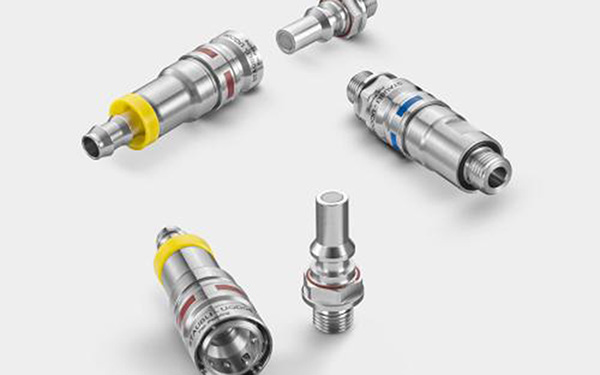
A UQD (Ultra-Quick Disconnect) is a high-precision quick connector designed specifically for liquid-cooling systems.Its primary function is to enable safe, zero-leak connections and disconnections of coolant lines while the system remains pressurized.
Unlike traditional quick couplings, the UQD features a dual-valve design.When the male and female ends are separated, both valves close simultaneously to prevent fluid leakage; when reconnected, the valves open in sync, allowing coolant to flow freely.
This “dry-break” structure keeps fluid loss during connection and disconnection to nearly zero—making it a key technology for meeting the high reliability and safety requirements of modern AI data centers.
In AI server cooling architectures, UQDs are typically installed between the cold plate and the supply manifold, or used to connect individual server modules to the rack’s main coolant loop.Their presence allows engineers to replace GPU modules or service liquid loops without shutting down the entire cooling system, significantly reducing maintenance time, minimizing downtime risk, and improving operational efficiency.
Because they must support both hot-swappable maintenance and high-reliability operation, UQDs are often referred to as the “joints” of liquid-cooling systems.
They must maintain perfect sealing under high pressure, high temperature, and frequent mating cycles—while also ensuring low pressure drop, high flow rate, and long-term durability.
To achieve this, every internal component—from the valve body, spring, and sealing ring to the flow path geometry—must be manufactured with extreme precision and tight consistency, ensuring long-term system safety and efficiency.
In the following section, we will take a closer look at how UQD’s internal structure enables pressurized connection and dry-break, zero-leak performance.
UQD Structure and Working Principle
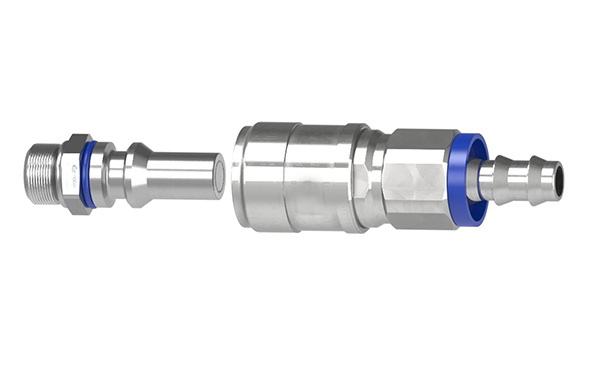
A UQD (Ultra-Quick Disconnect) is typically composed of a body, valve cores, springs, O-rings, and a locking mechanism.
Each component is precisely engineered to achieve pressurized connection and disconnection, zero leakage, and low-pressure-loss flow performance.
1. Valve Core and Spring — Enabling Pressurized Automatic Opening and Closing
Both the male and female ends of a UQD are equipped with independent valve cores.When disconnected, the internal spring pushes each valve core tightly closed to seal the fluid channel and prevent coolant leakage.
When connected, the valve cores are simultaneously opened by the locking motion, forming a continuous flow path.
This design allows liquid lines to be connected or disconnected safely under pressure, without splashing or air ingress—making it the foundation of hot-swap maintenance in liquid-cooled AI servers.
2. Sealing Structure — Ensuring Zero-Leakage Performance
High-quality UQDs typically adopt a dual-seal configuration: a primary seal to prevent leakage and an auxiliary seal to resist micro-seepage and pressure fluctuations.
Common sealing materials include EPDM and FKM (fluoroelastomer), known for their resistance to high temperatures and coolant corrosion.
The seal-groove depth and compression ratio are precisely controlled—tolerances usually within ±0.01 mm—ensuring reliable sealing performance even after thousands of mating cycles.
3. Flow Path Optimization — Minimizing Pressure Drop
The internal flow path of a UQD is often refined through Computational Fluid Dynamics (CFD) simulations to maintain smooth flow and minimal pressure loss during high-speed circulation.
To avoid turbulence or bubble formation, all internal transitions are rounded, and surfaces are CNC-machined and polished to a fine finish, achieving both stable flow rate and efficient heat transfer.
4. Locking Mechanism — Ensuring Safety and Durability
A lock sleeve or retaining ring secures the connection, preventing loosening caused by vibration or pressure fluctuations.
Some high-end models include anti-mismatch or anti-release safety locks, making them suitable for dense environments such as server racks and cold-plate manifolds.
Through this coordinated structural design, the UQD maintains reliable performance even in high-temperature, high-pressure, and frequent-connection environments.
It is more than just a connector—it is a critical node that combines safety, maintainability, and reliability within modern liquid-cooling systems.
Differences Between UQD and Traditional Quick Connectors
Although UQDs (Ultra-Quick Disconnects) and standard quick connectors may look similar in appearance, they differ fundamentally in structure, performance, and application scope.
A UQD is a higher-grade dry-break liquid-cooling connector designed to maintain zero leakage and high flow performance even under system pressure, whereas conventional quick connectors are typically used only in non-pressurized or low-pressure environments.
The following table compares the key distinctions between the two, offering a clearer view of their design and functional differences.
| Comparison Item | UQD (Ultra-Quick Disconnect) | Standard Quick Connector |
|---|---|---|
Internal Structure |
Dual-valve design enabling automatic open/close during connection and disconnection |
Single-valve or no-valve design; fluid easily leaks when disconnected |
Leakage Performance |
Dry-break mechanism keeps leakage virtually zero |
Noticeable fluid residue or splashing upon disconnection |
Operation Condition |
Supports pressurized connection and disconnection |
Must be operated under non-pressurized conditions |
Flow and Pressure Drop |
Optimized flow path for high flow rate and low pressure drop |
Higher flow resistance, prone to turbulence |
Durability |
Withstands tens of thousands of connection cycles with stable |
Seal performance degrades with long-term use |
Typical Application |
AI server liquid-cooling systems, data-center cold-plate modules |
Higher flow resistance, prone to turbulence |
Manufacturing Precision & Cost |
High machining precision, higher cost |
Simple Structure, lower cost |
Compared with traditional quick connectors, a UQD is closer to a hybrid of a precision valve and a sealing assembly.
It must not only ensure smooth coolant flow but also maintain pressure balance and sealing integrity during rapid connection and disconnection.
That is why, in AI servers, GPU racks, and high-density data-center environments, UQDs have replaced conventional couplings to become a core component ensuring continuous system operation and safe maintenance.
UQD Materials and Manufacturing Requirements
As a key component that operates under long-term pressure and frequent connection cycles, the UQD (Ultra-Quick Disconnect) demands exceptional precision in both material selection and machining accuracy.
Its valve body and valve core are commonly made from nickel-plated brass, stainless steel (304/316L), or anodized aluminum, balancing corrosion resistance, strength, and thermal conductivity.
Nickel-plated brass versions are widely used in standard AI-server cold-plate systems; stainless steel is preferred for high-pressure or high-temperature loops, while aluminum alloys serve lightweight or compact liquid-cooling devices.
During manufacturing, the valve body, valve core, and sealing grooves must meet very tight tolerances—typically within ±0.01 mm.
To ensure sealing reliability and long-term stability, each part undergoes CNC precision turning and polishing, followed by helium leak and flow-rate testing, achieving surface finishes better than Ra 0.8 µm and true zero-leak performance.
These demanding processes make the UQD a representative example of high-precision component engineering—an area where precision-machining companies can leverage their expertise.
Because of its high manufacturing and precision-control thresholds, the UQD has become not only a technical barrier within liquid-cooling systems but also a new growth opportunity for advanced manufacturing.
As liquid-cooling adoption accelerates across AI servers and data centers, suppliers capable of high-accuracy machining and customized production are becoming indispensable to the global liquid-cooling supply chain.
UQD Market Trends and Application Outlook
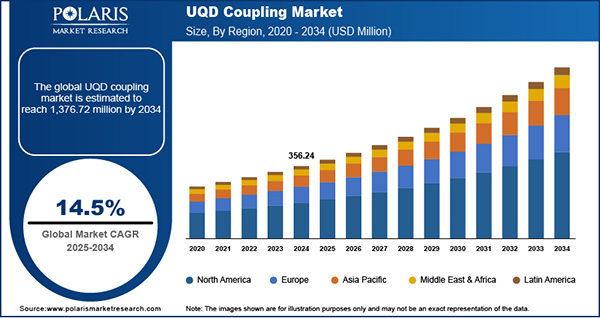
As AI computing power continues to surge, liquid-cooling systems are spreading at unprecedented speed across global data centers and high-performance computing (HPC) facilities.
According to industry research, by 2027 liquid-cooled servers will account for over 30 percent of all data-center deployments, with most systems adopting Direct-to-Chip or Rack-Level cooling architectures.
Within these designs, UQD connectors are rapidly becoming standard components.
1. The Shift Toward Fully Liquid-Cooled Data Centers
As AI models grow in parameters and power consumption, each GPU rack’s Thermal Design Power (TDP) continues to climb.
To manage such high heat densities, traditional air-cooled racks are gradually being phased out, with liquid cooling emerging as the dominant alternative.
In this transition, the UQD serves as a system-interface bridge, linking cold plates, distribution manifolds, and main coolant loops.
By enabling modular maintenance and hot-swap operations, UQD demand will rise sharply as liquid-cooling architectures scale from pilot deployments to mass adoption.
2. AI as the Primary Growth Driver
The boom in large language model (LLM) training, autonomous-driving algorithms, and edge computing is driving a rapid increase in AI-server deployments.
Leading chip makers—NVIDIA, AMD, Huawei Ascend, and Cambricon, among others—are already integrating liquid-cooling interfaces into their next-generation computing platforms.
This means that in the coming years, every AI server, cold-plate module, and rack-loop node will require multiple high-reliability UQDs as connection points—creating a multi-billion-dollar component market.
3. Expanding Application Scenarios
Beyond AI data centers, UQD technology is extending into other high-heat-density sectors, such as:
- Energy-storage systems– cooling of battery modules and converters;
- Industrial & medical laser equipment– enhancing thermal stability and maintenance efficiency;
- Edge-AI and mobile-computing devices– driving demand for smaller, lighter UQD variants.
These emerging fields are pushing UQD development toward miniaturization, higher flow capacity, and improved corrosion resistance.
Future connectors must not only maintain excellent sealing but also support recyclable materials, eco-friendly coolants, and standardized modular designs.
4. Future Outlook
As liquid-cooling standards such as OCP, ASHRAE, and ODCC become unified, UQD dimensions, material grades, and performance specifications will move toward full standardization.
This evolution will shift the market from custom development to modular, interoperable components, enabling tighter collaboration across the entire liquid-cooling ecosystem.
From server manufacturers to cooling-solution providers and upstream precision-component suppliers, UQD technology will remain essential to building stable, efficient AI-infrastructure systems.
Conclusion
In the fast-moving AI era, computing power drives progress, but thermal management defines its limits.
As liquid-cooling systems become the mainstream solution for AI servers and data centers, the UQD, with its safe, zero-leak, pressurized-operation capability, has become an indispensable component.
From structural design to sealing precision, every aspect of the UQD directly affects system stability and efficiency, giving liquid-cooling systems true modularity and maintainability.
Looking ahead, as AI models grow larger and data centers become fully liquid-cooled, UQD standards and manufacturing demands will continue to rise.
As a precision-machining manufacturer, we remain closely engaged with these developments—building our technical expertise and prototype validation capabilities to actively explore the manufacturing potential of liquid-cooling connectors in the AI era.