Abstract
I.Why is CNC Precision Machining for Robotics Hands More Challenging?
In various robotic systems, hand components, due to their complex structures, compact spaces, and multi-degree-of-freedom movements, are among the technically most challenging parts to manufacture. Compared to the robot body’s drive structures, hands not only perform precise operations but must also achieve human-like dexterity. This imposes high demands on part structural precision, assembly tolerances, and material performance.
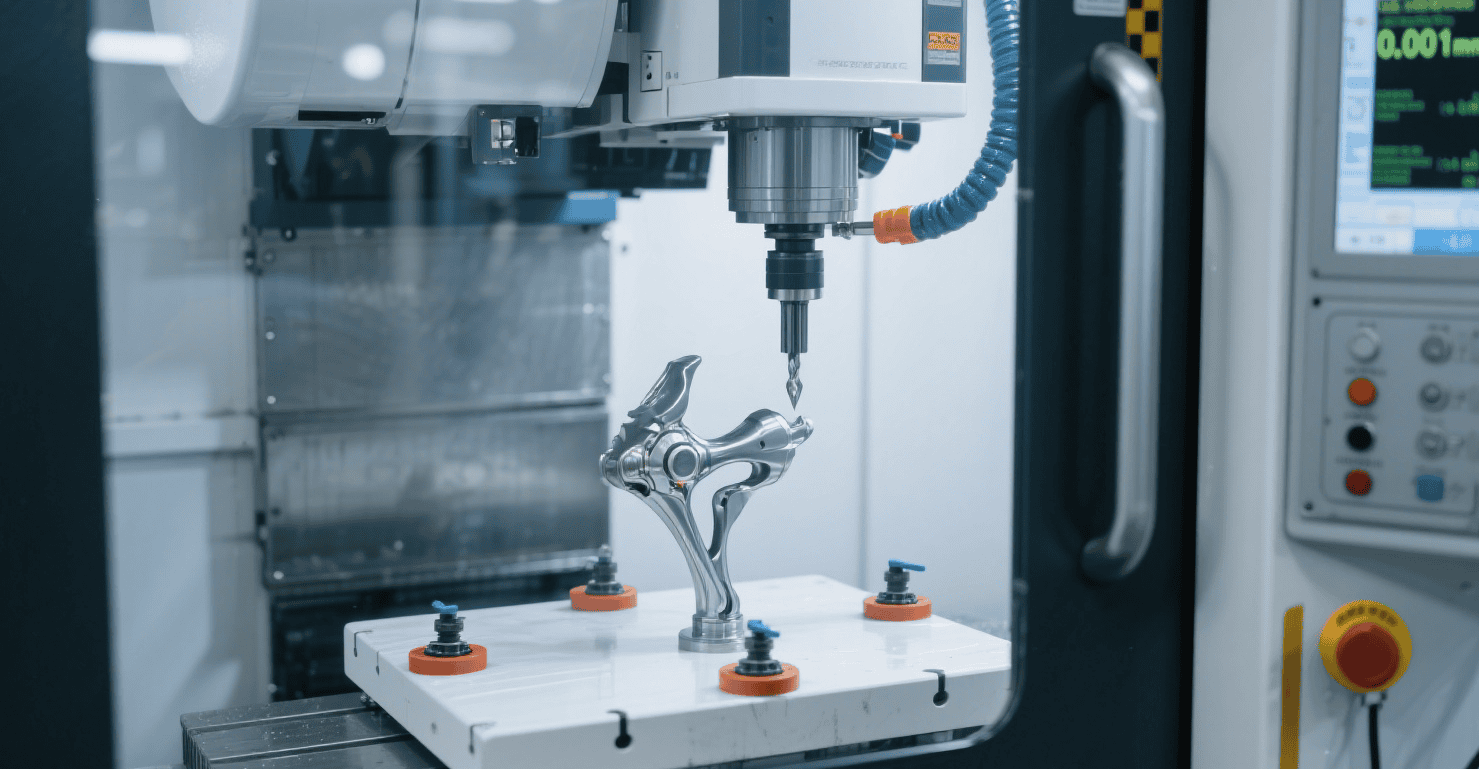
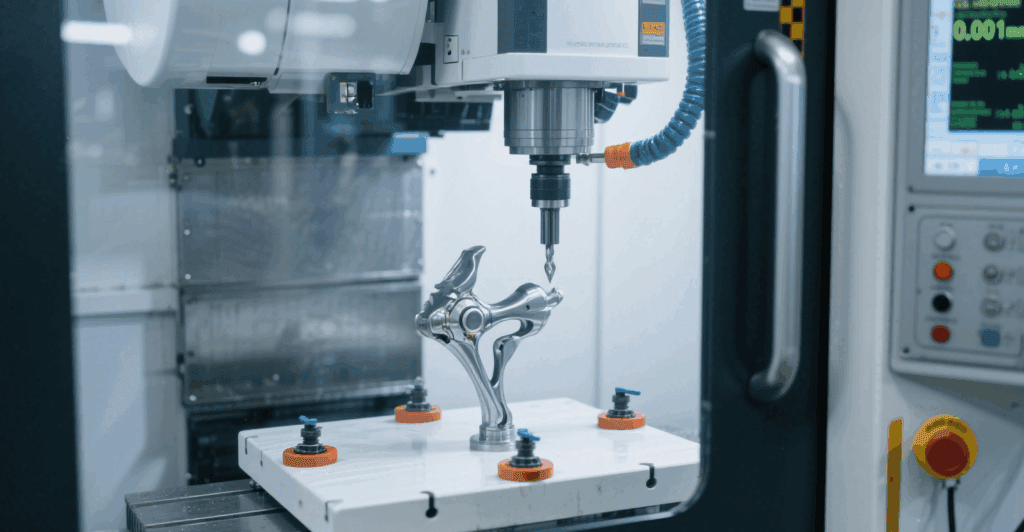
Among various manufacturing processes, CNC machining, with its high machining accuracy, strong material adaptability, and excellent support for complex structures, has become the widely adopted technology path for hand part manufacturing.
II. Hand Structure Breakdown: Which Parts Are Suitable for Precision CNC Machining?
Robot hands typically consist of numerous small parts covering driving, transmission, structural, and sensing modules. Common CNC-machined parts include:
- Joint links and finger bones: Require high strength and low tolerance control, often using lightweight metal materials;
- Motor brackets and sliding transmission structures: Require high assembly precision and complex multi-surface machining;
- Housings and load-bearing frameworks: Irregular shapes, compact sizes, typically made of aluminum alloys or composites;
- Sensor mounting positions: Require strict hole consistency and component alignment precision;
- Micro bushings and rotational support parts: Small size, precise bores, strict tolerance control.
These parts are often complex, produced in small batches, and updated frequently, making them unsuitable for traditional molding or die-casting processes, and better suited to CNC flexible manufacturing.
III.Advantages of Precicion CNC Machining Robotics Hand Manufacturing
The technical features of CNC machining align closely with the manufacturing requirements of robotic hand parts:
1. Strong precision control capabilities
Hand movements usually require highly coordinated operations, with multiple part fit tolerances controlled within ±0.01mm or less. CNC machining performs consistently in this regard, meeting high-precision motion control needs.
2. Excellent structural adaptability
CNC can process 3D surfaces, non-standard slots, and complex irregular shapes, supporting the bionic structures common in robotic design.
3. Wide material compatibility
Whether aluminum alloys, titanium alloys, stainless steel, or engineering plastics like PEEK and POM, CNC machining can achieve excellent product quality and surface finish.
4. Supports rapid iteration and prototyping
During product development, CNC machining enables rapid sample production without relying on molds, shortening the design validation cycle and accelerating product iterations.
5. Facilitates small-batch flexible production
For robotic products not yet in mass production, CNC is a cost-effective and flexible manufacturing option.
从原型设计到量产,我们为机器人工程师提供各个阶段可靠的数控解决方案。想了解我们如何应对实际挑战吗?[查看我们的机器人行业解决方案 →]
III. Machining Challenges and Coping Strategies
Despite its advantages, CNC machining of robotic hand parts faces several challenges, particularly in size, fixturing, and machining path planning. Common problems and solutions include:
| Challenge | Coping Strategy |
|---|---|
Small size, difficult clamping |
Use custom micro fixtures, magnetic or vacuum clamping |
Difficult multi-surface machining in one setup |
Use five-axis machines, rotary indexing fixtures, or multi-coordinate programming |
High precision requirements for micro holes and threads |
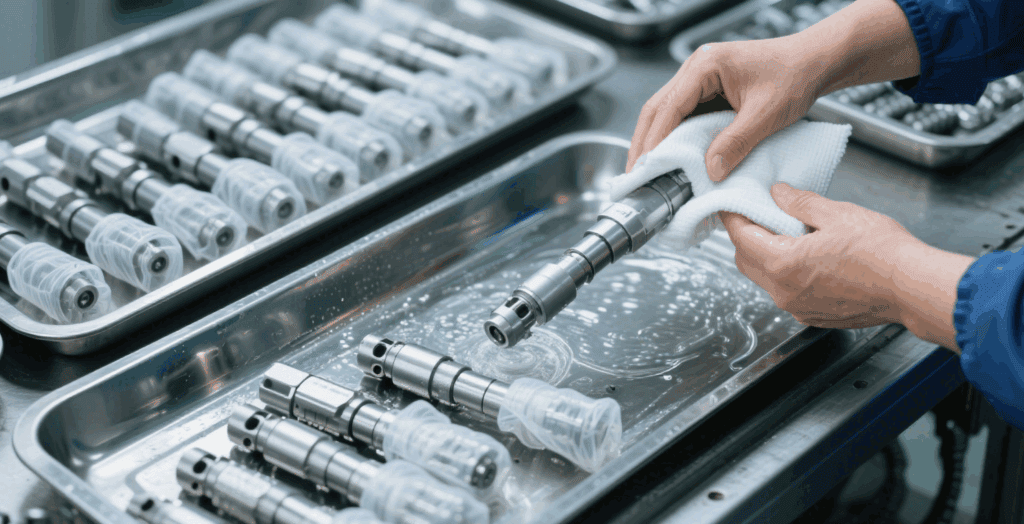
Use precision drilling-milling tools with digital measurement systems for process control |
High surface roughness requirements |
Use high-speed spindles, high-quality tools, and post-processing for finish improvement |
Through reasonable process path planning, precision equipment setup, and dedicated fixture design, machining quality and repeatability can be effectively ensured.
IV. Practical Case: High-Precision Bionic Hand Joint Part CNC Machining
In a smart bionic hand development project, the team designed a bionic hand with 22 degrees of freedom, containing nearly a hundred high-precision parts. A typical part, the “rotational finger joint bracket,” measures 14mm x 6mm, features multiple micro holes and threads, and requires precise mating with a servo motor.
We used a five-axis machining center, combined with custom fixtures and multi-coordinate segmented machining paths, to achieve high-consistency production. According to CMM inspections, critical dimension tolerances were controlled within ±0.008mm, and surface roughness Ra reached 0.4μm, meeting dynamic movement wear-resistance and low-noise operation requirements.
The customer achieved complete closed-loop action testing in the first full assembly, significantly improving system validation efficiency.
V. Conclusion: Future Evolution of Precision CNC in Robotic Hand Manufacturing
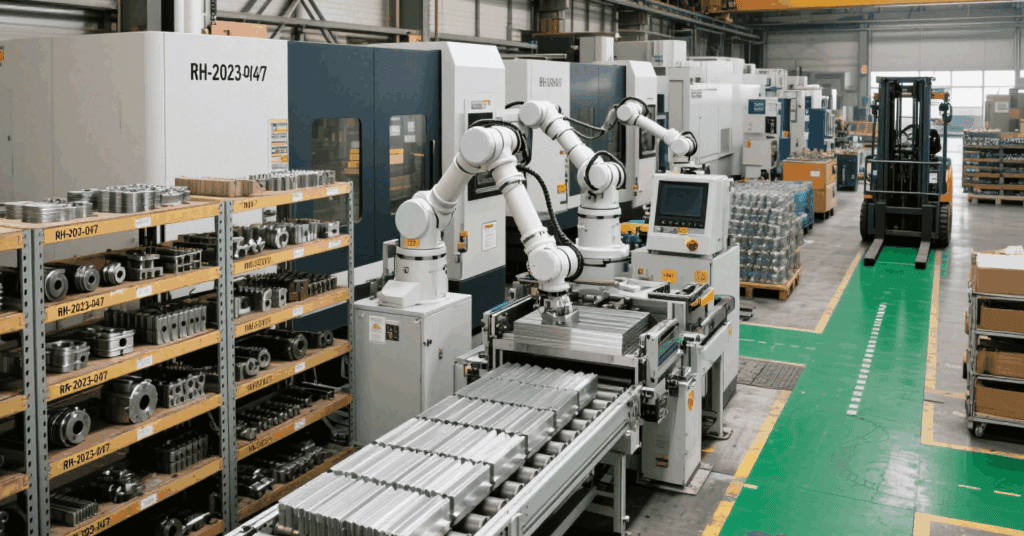
随着仿生结构、微型驱动系统和多材料集成设计的发展,机器人手部零件的制造挑战日益严峻。CNC加工凭借其过程可控性和灵活的制造能力,将在以下发展趋势中继续发挥作用:
- 对更高精度和复杂表面加工的需求日益增长;
- 针对轻量化和结构强度的多目标优化方法不断发展;
- 结合数控加工、增材制造和注塑成型的成熟混合工艺;
- 从原型验证转向稳定的小批量交付,小批量交付正成为常态。
数控加工不仅是现代精密制造的基础,它也正与先进技术共同发展,为下一代人形机器人提供动力。从结构框架到复杂的机械手部件,数控加工在实现高精度和可靠性能方面发挥着至关重要的作用。
想看看我们如何将机器人设计变为现实吗?
请访问我们的数控加工服务页面,了解我们的能力、材料选择以及我们如何根据您的具体要求量身定制解决方案。让我们一起打造具有影响力的产品——点击查看。
正在进行高精度机器人项目?
请分享您的图纸和需求——我们将提供加工方面的专业见解和量身定制的解决方案评估。
[点击此处联系我们的工程团队。]