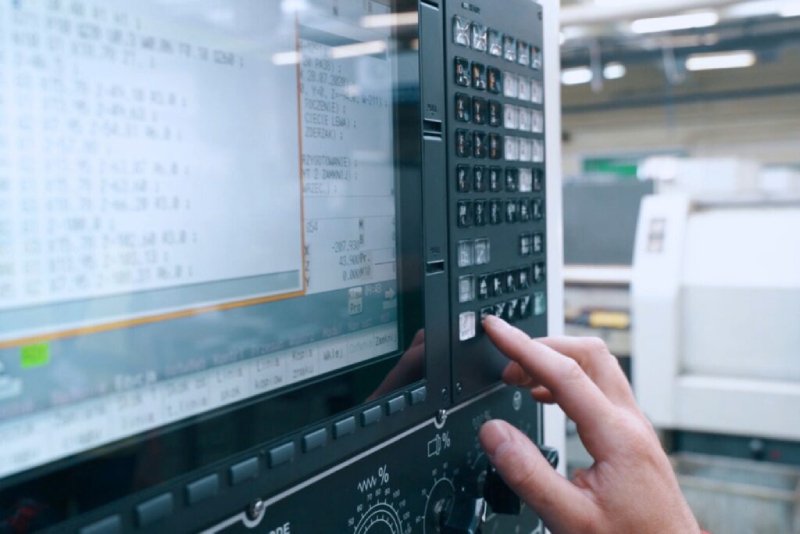
Introduction: CNC Programming (computer numerical control programming) refers to the process of converting part designs into CNC codes that the machine can recognise. These codes control CNC machine to automatically complete the precision machining of parts. This article will explore CNC programming’s definition, principles, types, and applications to help you better grasp its core characteristics.
I.What is CNC Programming
CNC programming refers to the technique of writing instruction programs for machine tools to automatically perform cutting, machining, and other operations. Simply put, it is the process of converting part designs (such as CAD drawings or models) into instruction codes (such as G-code or M-code) that CNC machine can understand and execute. This drives the machine to automatically perform machining actions like cutting and drilling, achieving high-precision, high-efficiency automated processing.

II.How Does CNC Programming Work?
The specific workflow of CNC programming consists of four steps:
Part Design
Engineers create 3D models of parts using CAD software. Designers then export the final model and transfer it to CAM software.
Path Generation
Most CAM software can automatically convert CAD models into toolpaths, or users can manually write paths. This step translates the model into G-code for CNC machines to read.
Path Simulation
Use CAM software or simulation tools to verify the accuracy of tool paths, checking for potential collisions between tools and workpieces or machine components to ensure no collisions or errors occur.
Machine Execution
Transfer the code to the CNC machine via USB flash drive or local connection, then initiate the machine to complete automated machining.
III. Types of CNC Programming
CNC programming is categorized into three types: manual CNC programming, CAM programming, and conversational programming. Below is a detailed introduction to each:
Manual CNC Programming
Programmers write G-codes and M-codes entirely by hand without software assistance. However, this method has a high error rate and low efficiency, making it suitable only for simple 2D contour machining and drilling. It is very convenient for producing simple parts.
CAM Programming
This is the most common CNC programming type, offering powerful capabilities to handle extremely complex geometries, making the CNC process more efficient and straightforward. It is very simple to execute, providing programmers with a high level of visualization, enabling faster detection of potential errors, inspection, and simulation. Although CAM programs require expensive software, they save significant time during use and improve programming efficiency.
Conversational Programming
Conversational programming is a simplified CNC programming method. Programmers do not need to memorise G-code. Instead, they answer questions posed by the system, which automatically generates the corresponding G-code. While this question-and-answer format is more engaging, its functionality is limited. It is only suitable for standard canned cycles, such as quick programming for simple operations, machining, and making repair parts.
IV. Common CNC Programming Codes
CNC machine tools are controlled by a specialized code called numerical control (NC) coding. The codes used for NC programming are represented by letters and fall into the following 7 categories:
G code
Geometric codes form the core instructions of NC programming. They issue fundamental preparatory commands to the machine tool, such as motion modes, machining modes, and coordinate settings, determining the tool’s movement trajectory and machining logic.
M Code
Miscellaneous instructions, also known as non-geometric codes, govern non-geometric actions of the CNC machine. They control auxiliary machine operations to complement G codes in executing the machining sequence.
D Code
Tool radius compensation code, primarily used in milling operations. It compensates for the tool’s inherent radius to achieve more precise machining dimensions.
F Code
Specifies the feed rate during cutting operations, serving as one of the core foundational codes in CNC programming.
N Code
Designates the unique sequence number for each instruction line within a program. It functions solely as a segment identifier and does not control any machine actions.
S Code
Specifies spindle speed. It must be used with M03 (clockwise rotation) or M04 (counterclockwise rotation).
T Code
Selects the machining tool. Often used alongside M6 (tool change code).
V. Common CAM Software
Numerous CAM software solutions exist, categorized into the following four types:
- Mainstream high-end integrated systems: Siemens NX CAM, CATIA CAM, Creo NC, Mastercam, PowerMill, HyperMILL
- Mid-range and specialized domain-focused CAM software: Fusion 360, SolidWorks CAM, GibbsCAM, ESPRIT, FeatureCAM
- Open-source and free CAM software: FreeCAD, CNC.js, Kiri:Moto
- Software for specific processes or industries: Mastercam Wire, Radan, Lantek
FAQ
Q:Should beginners learn manual programming first or jump straight into CAM software?
A:Beginners are advised to start with manual programming. Master the basic commands and machining principles before learning CAM software.
Q:What is the core difference between CAM programming and manual programming?
A:CAM programming uses software to automatically generate toolpaths and code, suitable for complex 3D machining. Manual programming involves hand-writing code, only suitable for simple 2D machining.