Ⅰ. Introduction
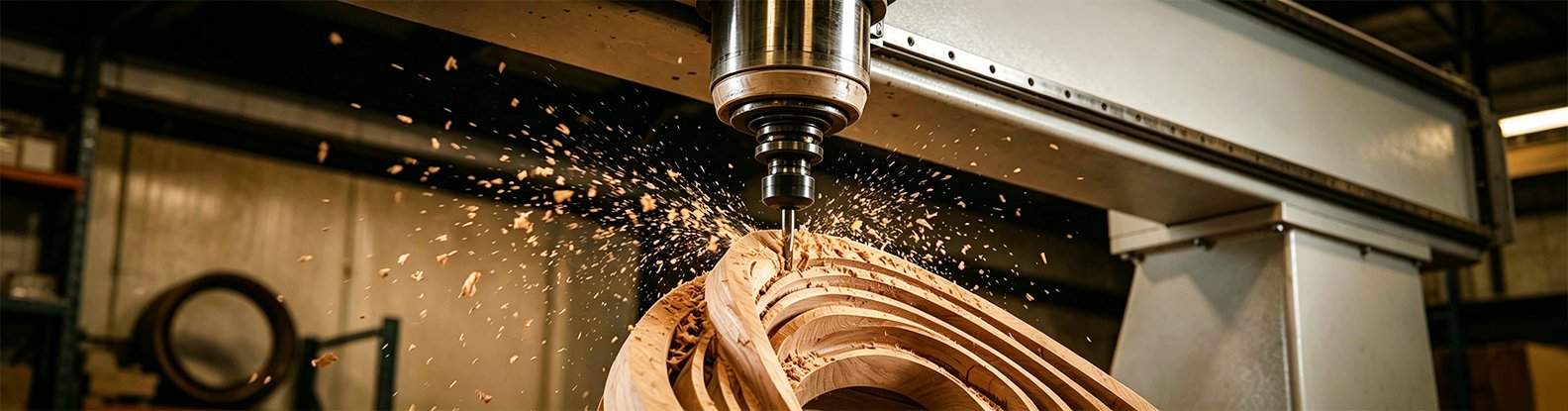
With the advancement of CNC technology, woodmachining has entered a digital era characterized by high precision and high efficiency. For product designers, understanding the principles, processes, material properties, and design constraints of CNC woodmachining ensures the feasibility of design solutions and is a key factor in guaranteeing consistent quality. This article aims to systematically analyze the core logic, material selection criteria, and key constraints of CNC woodmachining to help designers proactively avoid manufacturing defects.
Ⅱ. Can Wood be Processed Using CNC Machines?
Yes, CNC machining of wood is a very common method in the woodmachining industry. CNC woodmachining machines can perform a variety of processes, including cutting, grooving, carving, and routing. Various types of wood, such as solid wood, MDF, and plywood, are all suitable for processing with CNC equipment. Compared to manual craftsmanship, wood products made through CNC machining are more precise and efficient.
Ⅲ. How Does CNC Wood Machining Work?
CNC wood machining essentially replaces traditional manual operations with digital and software-based controls, and it is a core technology in the modern manufacturing of furniture and wood products. The core principle of CNC wood machining is as follows: using a computer numerical control (CNC) system, design drawings of wood are converted into executable instructions, which then automatically and precisely control the movement of the cutting tools and the wood, thereby enabling automated processes such as milling, cutting, drilling, and carving.
Ⅳ. Common CNC Machining Processes for Wood ?
CNC Milling
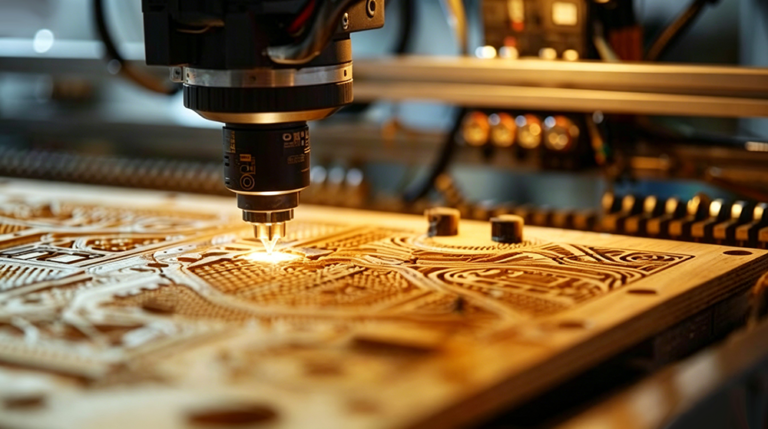
CNC milling is currently the most widely used and versatile process in CNC woodmachining. This process involves using a rotating milling cutter to remove material from the surface of the wood and shape it into the desired form. Milling is commonly used to create flat surfaces, curved surfaces, and complex relief patterns, making it ideal for applications such as furniture manufacturing, decorative arts, and model making.
CNC Turning
CNC turning refers to the process of using computer-controlled toolpaths to cut various rotational shapes from rotating wood. The core characteristic of turning is that the workpiece itself rotates at high speed. This method is particularly suitable for producing cylindrical or circular objects, such as vase-shaped columns, furniture legs, and cue sticks, and is therefore widely used in solid wood furniture, decorative panels, and decorative moldings.
CNC Sawing
CNC sawing is a primary process in the cutting stage, involving the use of milling cutters or saw blades to make straight or curved cuts in wood. The purpose of this method is to separate large-sized raw materials; it is frequently used to process straight and curved panels and is widely applied in the cutting of panel furniture and the preparation of solid wood.
CNC Drilling
CNC drilling is one of the most common processes in CNC woodmachining. Its core capability lies in the precise control of hole positions, depths, and diameters, as well as the ability to perform automated processing of multiple holes and surfaces. During the process, the equipment uses vertical or lateral feed of woodmachining drill bits to create round holes, rows of holes, and slot holes on the wood surface. It is widely used in the manufacturing of panel furniture, cabinets, and solid wood furniture to meet the requirements for joining, installation, and assembly.
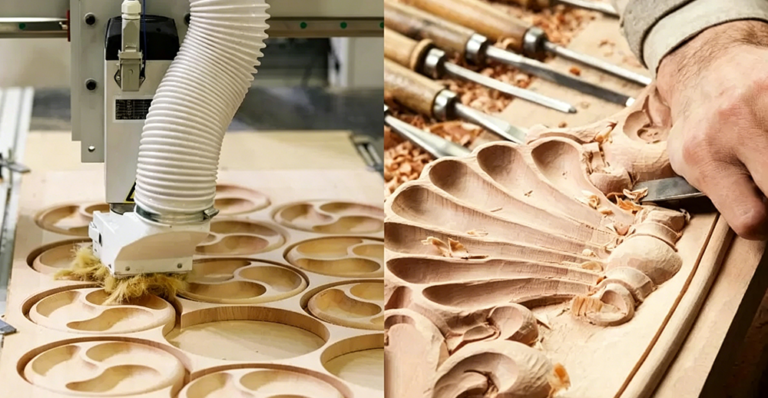
Now that we’ve covered the core processes of CNC wood machining, we’ll compare the differences between traditional wood machining and CNC wood machining from a broader perspective. The table below summarizes the characteristics of these two wood machining methods to help you determine which one best suits your needs.
| Process Type | Machining Precision | Production Efficiency | Cost Barrier | Suitable Applications |
|---|---|---|---|---|
Pure Handcrafted Wood Machining |
Relies on the artisan’s experience; tolerance ±0.5–2 mm |
Slow for single pieces; complex shapes increase time and cost; not suitable for mass production |
Low; minimal tooling investment; primarily labor costs |
Single-piece customization, handmade crafts, custom premium items |
CNC Milling |
Stable at ±0.1mm; high consistency in mass production |
Very high; repeatable machining with a single program; complex shapes can be completed efficiently |
High; high costs for equipment, software, and maintenance |
Furniture components, wood carvings, panels |
CNC Turning |
Rotary parts: ±0.1mm accuracy |
Extremely high; processing speed for rotary parts far exceeds manual methods |
Medium-high; relatively high equipment costs |
Table and chair legs, crafts, wooden handles |
CNC Sawing |
Straight cuts: ±0.2mm; curved cuts: ±0.3mm |
High; efficiency in panel cutting and batch slitting far exceeds manual methods |
Medium; CNC band saw costs |
Panel cutting, furniture panel cutting |
CNC Drilling |
Hole positioning accuracy ±0.1mm, depth control ±0.05mm |
High; efficiency for multi-hole processing far exceeds manual methods |
Moderate; drilling machine costs are moderate |
Hole positions for furniture connectors, hardware mounting holes |
Ⅴ. What Types of Wood are Suitable for CNC Machining?
Most types of wood are suitable for CNC machining, but the most suitable types vary depending on the wood’s physical properties and intended use. Commonly used woods can be divided into three main categories: hardwoods, softwoods, and engineered wood. The following table compares these wood types:
| Wood Type | Representative Woods | Machining Characteristics | Suitable CNC Machining | Suitable Applications | Machining Considerations |
|---|---|---|---|---|---|
Hardwoods |
Walnut, Maple, Oak, Cherry |
High density, high hardness, fine grain; causes significant tool wear |
High-precision milling, fine carving, 3D surface machining, complex contour machining |
High-end solid wood furniture, decorative moldings, high-end crafts |
Tools wear easily; carbide and diamond-coated tools are recommended; reduce feed rate to prevent tool overheating. |
Softwoods |
Pine, Cypress, Spruce |
Low density, soft texture, low hardness, low cutting resistance, easy to machine, but coarse grain and prone to fuzzing |
High-speed cutting, rapid material cutting, shallow relief carving, large-scale contour machining |
Architectural structural components, carved decorations, cabinet panels, large-scale low-cost models |
Prone to burrs and tearing; requires sharp tools; ensure proper dust extraction to prevent dust from affecting machining accuracy. |
Engineered Wood Panels |
MDF, Plywood |
Prone to burrs and tearing; requires sharp tools; ensure proper dust extraction to prevent dust from affecting machining accuracy |
Batch panel cutting, drilling and hole patterning, 2D engraving, cabinet structure fabrication . |
Cabinet door profiling, large flat panels, advertising wood carvings |
MDF processing generates heavy dust; effective dust extraction is essential; plywood is prone to delamination and chipping, so specialized cutting tools should be prioritized. |
Ⅵ. Key Design Rules for Wood Machining
In CNC wood machining, adhering to certain key design rules can improve finished product quality, reduce costs, and minimize machining errors. The following rules are intended to help designers avoid common issues and enhance the manufacturability of their designs as well as the quality of the final product.
- Wall Thickness and Detail Dimensions
- Recommended minimum wall thickness: ≥3 mm. Structures that are too thin are prone to fracturing along the grain of the wood; 3 mm is a common industry lower limit that balances aesthetics with machinability.
- Recommended minimum engraving height: ≥5 mm. Fine text and images are prone to chipping during engraving, resulting in blurred or illegible text. The recommended font width should be 15%–20% of the height.
- Single-pass cutting depth for grooves ≤ 6mm. Excessively deep grooves require multiple layered cuts, which increases processing time and may result in a rough surface. If deep grooves are required, design them for layered machining.
- Grain Direction
- When slotting or engraving, process along the grain as much as possible to minimize cutting against the grain, thereby preventing chipping and fuzziness.
- For slender parts, align the length with the grain direction. When designing load-bearing slender components—such as table legs or handles—ensure the longest edge runs parallel to the grain.
- Avoid making right-angle cuts along the grain direction, as this directly severs the fibers and creates stress concentration points. If necessary, use chamfers or rounded transitions to distribute stress.
- Part Joining and Assembly
- Allow for wood expansion and contraction. Use standard tolerances along the grain direction; for joints perpendicular to the grain, allow an assembly gap of 0.1–0.3 mm.
- For adjacent components such as frames and panels, or legs and crossbars, try to align the grain at an angle (90° or 45°) to ensure consistent grain direction within the same assembly
- Avoid stress concentrations at sharp corners at connection points, as sharp corners are common crack initiation points and prone to splitting. Therefore, round off the edges of tenon shoulders, the bases of slots, and the junctions of connecting arms with a radius (R) of ≥1 mm
Ⅶ. Common Defects in CNC Wood Machining
The core challenge of quality control in CNC woodmachining lies in the prevention and resolution of various processing defects. Only by fully understanding the causes of these defects can they be avoided during the design phase, thereby fully leveraging the high precision and efficiency of CNC machining. The following outlines common types of defects, detailing where they typically occur, their impact on the product, and recommendations for the design stage:
| Defects | Common Locations/Design Features | Impact on the Product | Recommendations for the Design Phase |
|---|---|---|---|
Tearing/ Chipping |
Complex textures, areas against the grain |
Edge Chipping, roughness |
Avoid excessively sharp corners; add fillets to critical edges |
Scorching |
Bottoms of deep grooves, enclosed cavities |
Blackened, carbonized surface; affects aesthetics and coating adhesion |
Avoid designing grooves that are too deep (>5 mm) or too narrow (<2 times the tool diameter); add chip-removal holes in enclosed areas |
Fuzz |
Long cuts along the grain, edges of thin sheets |
Rough texture, poor coating adhesion |
Design grain-aligned surfaces to be hidden; use bold fonts for engraved text and avoid long, thin strokes crossing the grain |
Delamination |
Edges of plywood, bottoms of grooves |
Delamination, reduced structural strength |
Add fillets at corners; design panel edges to be hidden or apply edge banding |
Vinration Marks |
Large flat surfaces undergoing finishing, curved transitions |
Wavy surface patterns, low dimensional accuracy |
Avoid excessively large flat surfaces on critical aesthetic areas; design textures or patterns to mask marks; specify sanding requirements |
Ⅷ. Conclusion
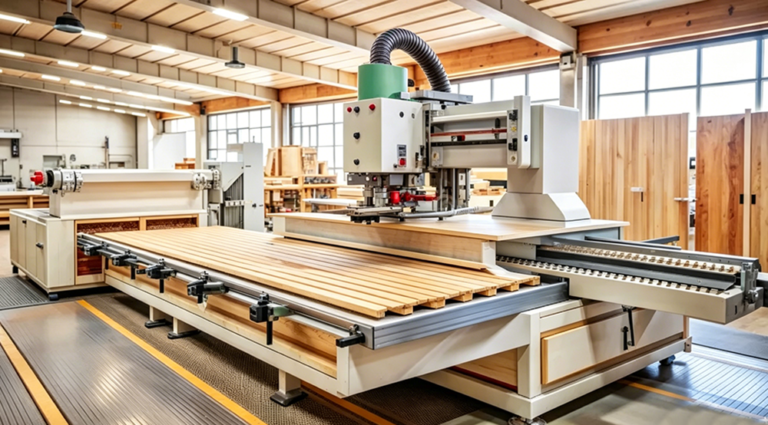
CNC woodmachining is a core technology in modern wood manufacturing. Through digital control, it enables precise milling, turning, sawing, and drilling of wood, making complex shapes, high-precision fits, and mass production possible.
For product designers and engineers, mastering the characteristics of CNC woodmachining and understanding the design rules are essential. By identifying and mitigating potential risks before the design phase, they can strike a balance between creativity and craftsmanship, resulting in high-quality wood products that are both aesthetically pleasing and feasible to produce.
Ⅸ. FAQ
- Can wood be machined to high precision tolerances?
Wood can be machined to a certain degree of high precision, but since natural wood is susceptible to temperature and humidity, achieving consistent high precision requires the use of engineered wood materials such as MDF or birch plywood in conjunction with CNC machining.
- Which type of wood is best suited for CNC machining?
Considering machining precision, detail rendering, and stability, hard maple and black walnut are the best choices for CNC machining. If you prioritize cost control and resistance to warping, MDF is a more reliable option and is ideal for painting.
- Does wood crack during the machining process?
Yes, wood may crack during machining. Excessive moisture content, excessive feed rates, and cutting against the grain are all common causes of cracking. Selecting well-dried boards and cutting with the grain can significantly reduce cracking.
- What is the difference between CNC wood machining and traditional wood machining?
CNC wood machining offers high precision and speed, relying on computer programs for shaping, making it suitable for mass production and complex designs; traditional wood machining is more flexible, excels at personalized, meticulous craftsmanship, but takes longer.