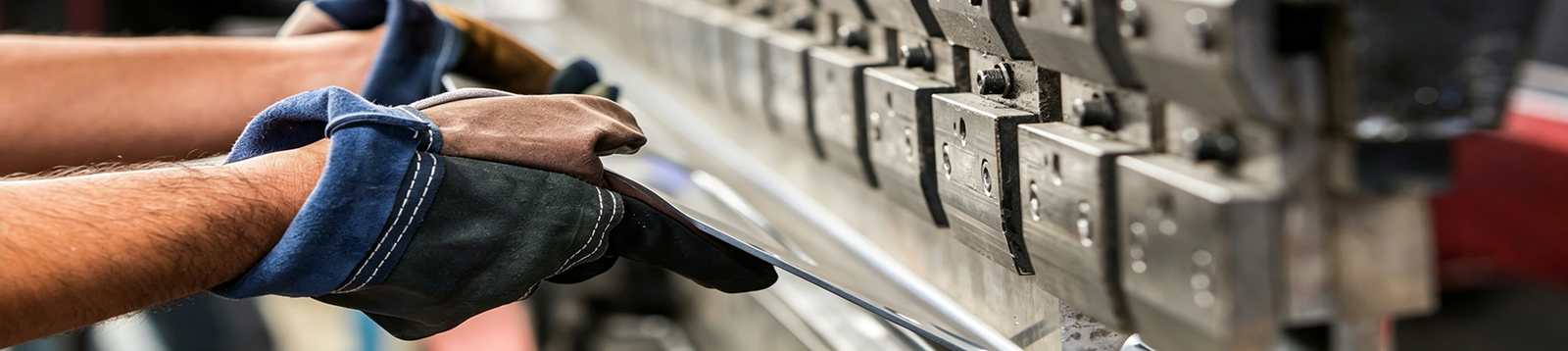
Malleability is a material’s ability to undergo plastic deformation under compressive force without cracking or breaking. A malleable metal can be hammered, pressed, or rolled into a new shape, including thin sheets. This property is central to forging, rolling, stamping, and other metal-forming processes.
Three points follow. The load is mainly compressive, which separates malleability from ductility. The deformation is permanent, so the material does not spring back. And what is malleability for a given part is never settled by the metal’s name — temperature, composition, and condition move the limit.
Ⅰ. What Is Malleability?
The malleability definition in engineering terms is the capacity to be deformed permanently in compression without fracture. Plastic deformation is the mechanism: the material changes shape and keeps it after the load is removed. Elastic deformation recovers, which is why a part springs back when a press releases.
Hammering, pressing, and rolling show the same result — a compressive load reduces thickness and extends surface area. A malleable metal thins and spreads; a brittle material in the same press shatters.
The term is used mostly for metals, though plastic deformation is not exclusive to them; polymers and clays flow under load too. Metals dominate because forging, rolling, stamping, bending, and extrusion are the processes a fabricated part passes through.
Malleability Is Not the Same as Softness
Malleability does not simply mean that a material is soft. A soft material may deform easily, but engineering suitability also depends on strength, toughness, temperature, material condition, and the required manufacturing process.
Softness measures resistance to indentation; malleability measures whether material can be reshaped in compression before it fractures. A soft but brittle material deforms little before cracking, while a harder material with good compressive flow can form cleanly. Hardness numbers do not answer what is a malleable metal.
Ⅱ. How Does Malleability Work?
Deformation happens by slip. Planes of atoms slide past one another, and dislocations move through the lattice so sliding occurs at far lower stress than breaking bonds would take. Metallic bonding is non-directional, so atoms rearrange without losing cohesion — the reason metals can be reshaped rather than only broken.
The limit appears when local strain outruns what the structure can accommodate. Inclusions, porosity, and surface defects concentrate stress and start cracks. Compression also generates local tension: friction at the die faces makes the material barrel and pull on free surfaces.
Malleability does not mean any shape can be formed without cracking. The outcome varies across malleable metals with thickness, bend radius, friction, strain path, and forming speed as much as with the property itself.

Ⅲ. Malleability vs Ductility
Malleability describes plastic deformation mainly under compressive loading, while ductility describes plastic deformation under tensile loading. Both measure how much permanent shape change a material tolerates; the direction of the load separates them.
| Property | Malleability | Ductility |
|---|---|---|
| Main loading condition | Compression | Tension |
| Typical action | Hammering, pressing, rolling | Pulling, stretching, wire drawing |
| Typical product form | Sheets, forgings and formed shapes | Wire, drawn tube and stretched sections |
| Common example | Metal rolled into a sheet | Metal drawn into a wire |
| Typical evaluation | Forming or compression behavior | Elongation and reduction of area in tensile testing |
| Main failure concern | Cracking during forming | Fracture during stretching |
The two usually travel together without being the same measurement. A very ductile metal is often malleable as well, but the relationship is not guaranteed — a material can stretch far in tension and still crack when compressed and spread. Treating ductile and malleable as synonyms hides that gap.
Bending mixes the two: the inner surface is in compression, the outer in tension, so bend performance cannot be predicted from malleability alone. Bend radius, grain direction, thickness, and condition move the result.
Ⅳ. Examples of Malleable Metals
The table is qualitative, not a ranking. Absolute values are not comparable across sources, because the measurement depends on test method and material condition.
| Material | General malleability | Manufacturing relevance | Important qualification |
|---|---|---|---|
| Gold | Extremely high | Foil, decorative and electrical applications | Expensive and rarely selected for structural parts |
| Silver | Very high | Electrical parts and formed products | Grade and purity affect behavior |
| Aluminum | High in suitable grades and tempers | Sheet forming, enclosures and lightweight parts | 6061-T6 and 7075-T6 are less formable than annealed grades |
| Copper | High | Electrical components, tubing and formed parts | Work hardening may reduce further formability |
| Lead | Very high | Specialized shielding and formed products | Low strength and toxicity limit applications |
| Mild steel | Moderate to high depending on grade | Stamping, bending and general fabrication | Carbon content and material condition matter |
| Stainless steel | Grade-dependent | Enclosures, brackets and formed components | High work hardening and springback can complicate forming |
These examples of malleability share one trait: the material flows instead of fracturing. They differ in what a project cares about — strength, cost, corrosion behavior, and surface response.
The Most Malleable Metal
Gold is generally considered the most malleable metal. It can be rolled and hammered into extremely thin foil without fracturing, which is why it appears in decorative and electrical work where very thin sections are required.
The caveat is immediate. Gold is expensive and low in strength, rarely appropriate for a structural part. Being the most malleable metal is a fact about behavior, not a recommendation for a drawing.
Pure metals and alloys differ, and so do conditions: the same base metal annealed, cold worked, or heat treated will not form the same way. A grade designation is the starting point; the condition is the other half.
Ⅴ. What Factors Affect Malleability?
Temperature
Many metals deform more readily as temperature rises — the basis of hot forging and hot rolling. Higher temperature lowers flow stress and allows larger shape changes in fewer operations. Hotter is not automatically better: excessive heat brings oxidation, grain growth, and hot shortness.
Alloy Composition
Alloying elements raise strength, and that gain often costs formability. Pure aluminum flows differently from a high-strength alloy, and the two should never be treated as interchangeable in a forming review.
Heat Treatment and Material Condition
Annealing typically restores part of the capacity that cold work or hardening removed. Quenching and aging can reduce formability in the finished condition. Any claim that a material forms well needs the alloy and condition attached.
Work Hardening
Metals often harden as they are cold formed. Each pass needs more force and the remaining forming margin shrinks — which is why a part that forms cleanly once can split on the second operation.
Grain Structure and Impurities
Grain size, inclusions, and phase distribution decide where a crack starts. Inclusions line up in the rolling direction and create planes of weakness; porosity does the same in cast stock.
Strain Rate and Forming Geometry
Forming speed, thickness, corner radii, and friction change the result. A fast press stroke and a slow one impose different strain rates. Malleability is not a fixed verdict but a verdict under specific conditions.
Ⅵ. Why Is Malleability Important in Manufacturing?
Every process below relies on the material flowing rather than fracturing, which is why malleability in manufacturing shows up as a production constraint before it shows up in a datasheet. Keywin’s metal parts manufacturing capabilities span several of these routes.
Forging
Forging drives metal into a die impression under compressive force. Adequate malleability reduces laps, surface cracking, and internal defects. Forging temperature and material condition are confirmed per alloy — a general statement about a metal family is not enough. Keywin’s precision forging service covers how those parameters are set.
Rolling
Rolling reduces thickness or forms a profile by passing material between rolls. Insufficient deformation capacity produces edge cracking, surface tears, or fracture at the roll gap. Rolling direction also sets grain flow, which affects later forming and machining.
Stamping and Sheet Metal Forming
Stamping, drawing, and local forming require the sheet to survive complex strain paths. Formability is not decided by malleability alone: ductility, anisotropy, work hardening, thickness, and tooling all contribute, and a material that passes a compression test can still split in a deep draw. Keywin’s sheet metal prototyping tests those limits before a tool is cut.
Bending
The inner surface is compressed and the outer surface stretched, so bend performance cannot be judged on malleability alone. Minimum bend radius, grain direction, thickness, and condition decide whether the bend is clean. Springback adds a second problem, and it tracks yield strength rather than malleability.
Extrusion
Extrusion pushes material through a die under pressure. Flow stress, temperature, friction, and die design determine whether the profile emerges sound. Limited deformation capacity can cause tearing at the die bearing or incomplete fill in thin sections.

Ⅶ. Does Malleability Affect Machinability?
Malleability can influence machining behavior, but it does not determine machinability by itself. Forming depends on how much strain a material tolerates; machining depends on how it separates under a cutting edge.
- Gummy, high-plasticity materials produce long stringy chips that tangle, and burrs form more readily where material bends rather than shears.
- Built-up edge appears when soft material welds to the cutting edge, degrading finish and dimensional consistency.
- Brittle materials give short chips, but can chip or crack at the exit edge.
- Tool geometry, speed, feed, coolant, and material condition often shift the result more than material choice does.
Ease of forming is not ease of machining, which matters on parts formed first and finished by CNC. Keywin’s CNC machining services cover how condition is matched to the features that follow.
Ⅸ. How Engineers Should Evaluate Malleability
There is no single table to look up, so work through the part:
1. Confirm whether the feature sees compression, tension, bending, or a mixed strain path.
2. Confirm the alloy, temper, and stock form — a grade name without a condition is incomplete.
3. Check supplier data for the delivered condition, not the generic datasheet.
4. Read temperature, forming amount, thickness, and minimum bend radius together.
5. Run a forming trial where risk is high: thin walls, tight radii, expensive stock.
6. Judge strength, toughness, hardness, corrosion resistance, and downstream machining at once.
One constraint shows up in every review. Unlike tensile ductility, which is commonly reported using elongation and reduction of area, malleability does not have one universal numerical value used across all materials and forming processes. Compressive tests, rolling reduction, and bend tests each answer a different question, so a number without its method is not usable.

Ⅹ. How to Select a Material for Formed Parts
A material list that says “malleable” narrows nothing. The decision needs the actual part:
- Final strength, thickness, and geometry — a grade chosen for forming margin may need later heat treatment, which can move dimensions.
- Grade, temper, and heat treatment side by side — annealed stock forms easily; the same alloy in T6 or cold-rolled condition may crack.
- Downstream steps — machining, welding, heat treatment, or coating after forming each change which starting condition is preferable.
- Volume, tooling cost, and consistency — a prototype can absorb hand work that production cannot repeat.
- A DFM review against the drawing and process route — forming limits, bend radii, grain direction, and machining allowance are cheaper to settle before tooling.
XI. Conclusion
Malleability is the capacity to deform permanently in compression without cracking, and it sets what forging, rolling, stamping, or bending can achieve. It is not ductility, softness, or machinability, and its limit depends on temperature, alloy, condition, and the strain path the part sees.
Selecting a metal for a forged, formed, or machined component requires more than comparing one material property. Send Keywin your CAD model, drawing, material requirements, and expected production quantity for a manufacturing and material review.
Frequently Asked Questions
1. Is malleability a physical or chemical property?
It is a physical and mechanical property. The material changes shape without changing its chemical composition. That is why annealing or cold work alters malleability without turning the metal into a different substance.
2. What is the difference between malleability and ductility?
Malleability describes plastic deformation under compressive loading; ductility describes it under tensile loading. Hammering a sheet tests the first, pulling a wire through a die tests the second. A metal can be strong in one and limited in the other, so both belong in a material review.
3. What is the most malleable metal?
Gold is generally considered the most malleable metal, capable of being rolled into very thin foil without fracturing. For selection it is one input only: cost, strength, corrosion behavior, and the process decide whether it belongs in the part.
4. Does heating increase malleability?
Many metals deform more readily at elevated temperature, which is why hot forging and hot rolling exist. The effect depends on the alloy and its process window. Excessive heat can cause oxidation or grain growth, so the range is set per alloy.
5. How is malleability measured?
There is no single universal malleability value applied across all materials and processes. Assessment combines compression testing, rolling reduction, bend tests, or forming trials with material standards and process data. The test should match the deformation the part will actually see.
6. Is a malleable metal easy to machine?
Not necessarily. Highly plastic materials can produce long chips, built-up edge, and burrs, while brittle materials may chip at the edges. Machinability also depends on hardness, thermal conductivity, tooling, and cutting parameters. Forming ease and machining ease are separate assessments.