Ⅰ. Introduction
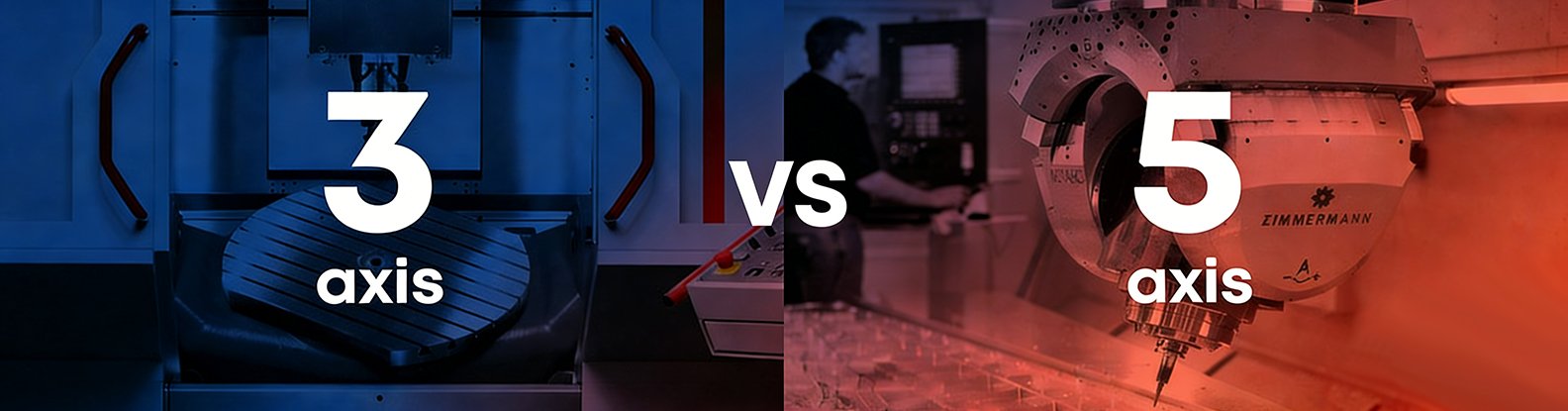
In the field of modern CNC machining, both three-axis and five-axis CNC machine tools represent core technologies. However, they exhibit fundamental differences in machine structure, degrees of freedom, and machining capabilities. This article aims to provide an in-depth analysis of the technical distinctions and application scenarios between the two. Through clear comparisons, it assists you in understanding the machining requirements for different parts in actual production, enabling precise and efficient selection of equipment and processes.
Ⅱ. What Is a Three-Axis CNC Machine Tool?
A three-axis CNC machine tool is the most fundamental and widely used type of machine tool in CNC machining. Through a computer numerical control system, it enables precise coordinated movement of the cutting tool or workpiece along three mutually perpendicular linear axes (X/Y/Z), performing conventional cutting operations such as milling and drilling on the workpiece.
Ⅲ. What Can a Three-Axis CNC Machine Tool Process?
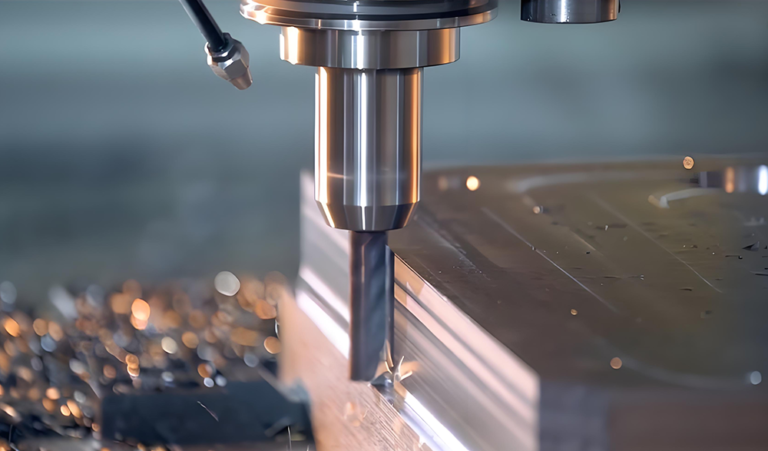
A three-axis CNC machine tool primarily processes parts through the coordinated movement of its X/Y/Z linear axes. Its processing scope covers most conventional mechanical components and supports mainstream milling and drilling processes. Specific applications are categorized as follows:
- Flat and Contour Parts
Suitable for equipment bases, panels, and various plate-like components. Efficiently performs large-area milling to achieve smooth, flat surfaces.
- Hole Pattern Parts
Suitable for engine blocks, gearbox housings, and mold templates. Capable of drilling, tapping, and other hole machining operations, ensuring precise spatial relationships between holes.
- 2D Parts
Suitable for cavities in phone cases and appliance housings, automotive stamping dies, and text engraving on signage. Utilizes three-axis interpolation to create complex 2D surfaces and simple 3D surfaces;
- Thread Machining
Employs thread milling cutters for internal and external threads, offering greater strength and processing flexibility compared to traditional tapping methods.
Ⅳ. What Are the Advantages of Three-Axis CNC Machine Tools?
- Low acquisition and maintenance costs: Three-axis CNC machine tools feature low purchase and maintenance expenses, simple structures, fewer malfunctions, readily available spare parts, and widely accessible repair techniques.
- User-friendly operation and programming: Eliminates complex rotary axis coordination, simplifies manual programming, enables rapid setup, and allows new operators to become proficient through training, reducing labor costs;
- High versatility: Covers machining for most 2D parts, accommodates various materials and basic processes, and supports single-piece, small-batch, and mass production without causing resource wastage.
Ⅴ. What Are the Disadvantages of Three-Axis CNC Machines?
- Significant processing limitations: Only handles simple 2D planes; cannot process complex spatial surfaces. Difficult to machine deep cavities and side walls, leading to tool wear;
- Low efficiency: Cannot complete single-setup machining. Workpieces require multiple setups, prone to positioning errors that affect part accuracy and further reduce efficiency.
Ⅵ. What Is a Five-Axis CNC Machine Tool?
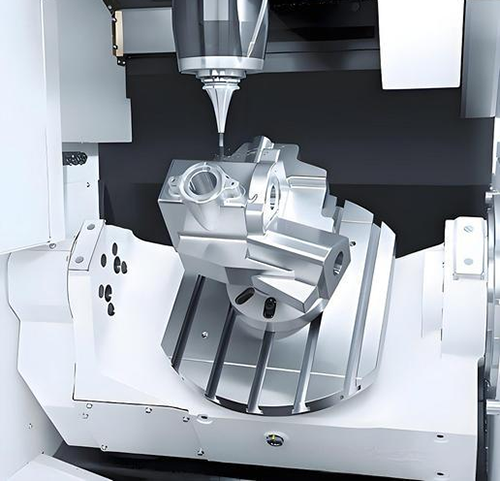
A five-axis CNC machine tool is an advanced machining device that builds upon a three-axis CNC machine by adding two additional rotary axes (any two of the A/B/C axes). Through a computer numerical control system, it achieves precise coordinated movement of the tool or tooling across five axes. This enables the machine to perform high-precision machining of complex surfaces, deep cavities, and other features from any angle with a single setup.
Ⅶ. What Can a Five-Axis CNC Machine Tool Process?
Leveraging its multi-axis interpolation capabilities, a five-axis CNC machine tool primarily processes parts with complex geometries, high precision requirements, and those difficult to complete with a single setup.
Typical applications include the following categories:
- Complex spatial surface parts
Suitable for aerospace engine blades, three-dimensional cavities, and other complex surfaces, enabling cutting at various tool angles;
- Multi-faceted/inclined-feature parts
Suitable for inclined holes, inclined slots, robotic joint arms, etc., completed in a single setup without multiple clamping, reducing instances of error occurrence;
- High-precision structural components
Suitable for titanium alloy aerospace frames, integrated irregular parts for new energy vehicles, featuring highly concentrated processes with precision exceeding traditional methods.
Ⅷ. What Are the Advantages of Five-Axis CNC Machines?
- Single setup: Five-axis machines complete complex surface machining in a single setup, eliminating repeated repositioning. This significantly enhances workpiece accuracy and avoids errors caused by fixture wear.
- Superior surface quality: Flexible tool angle adjustment via rotary axes achieves optimal cutting posture, enabling deep spatial machining unattainable with three-axis machines. More stable cutting forces result in lower surface roughness and smoother finished surfaces.
- High machining efficiency: Multi-axis interpolation and continuous machining eliminate auxiliary time spent repeatedly removing/reinstalling workpieces and recalibrating, substantially boosting productivity.
Ⅸ. What Are the Drawbacks of Five-Axis CNC Machines?
- High cost: Significant initial investment and ongoing part maintenance expenses, coupled with the need for specialized high-performance cutting tools that command premium prices due to their high precision requirements;
- Complex programming and debugging: Programming demands precise control over tool orientation and rotational axis trajectories, requiring highly skilled operators proficient in specialized CAM software; New machines also require repeated trajectory verification, resulting in significant debugging costs and extended lead times;
- Limited application scenarios: In many cases, five-axis machines are actually an uneconomical choice. For simple planar or straight-surface machining, they offer lower cost-effectiveness than three-axis CNC machines, often leading to low efficiency and resource waste.
Ⅹ. Three-Axis vs. Five-Axis Machining
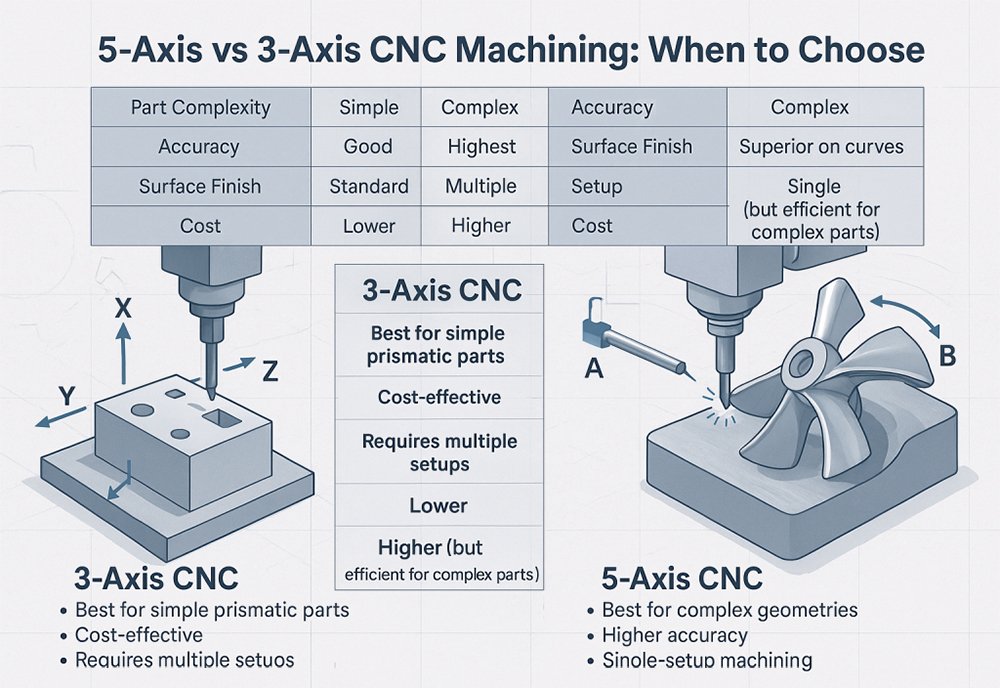
| Comparison Dimensions | Three-Axis CNC Machine | Five-Axis CNC Machine |
|---|---|---|
Core Axis System |
Three linear axes (X/Y/Z), no rotary axes |
Three linear axes (X/Y/Z) + two rotary axes (A/B/C combinations) |
Machining Posture |
Perpendicular machining to the workplane |
Any spatial posture, tool adjustable at multiple angles |
Clamping Method |
Multiple setups, single-sided setup in one go |
Single Setup |
Processing Scope |
Plane, cavity, two-dimensional, simple three-dimensional contour |
Capable of machining complex spatial surfaces and multi-faceted irregular structures |
Core Advantages |
Low acquisition and maintenance costs; easy programming and operation; strong adaptability for conventional machining |
High precision; faster machining efficiency; greater machining capability
Core Disadvantages |
Core Shortcomings |
Significant limitations in machining applications; repeated clamping operations are prone to generating errors. |
High costs; high barriers to entry for personnel; prone to resource wastage when processing simple parts. |
Suitable Applications |
Mold cavities, plate components, housing parts, mechanical structural components |
Aerospace structural components, machined impellers, artificial bones, high-end molds |
XI. Cost Differences Between Three-Axis and Five-Axis Machines
| Cost Dimension | Three-Axis CNC Machine | Five-Axis CNC Machine |
|---|---|---|
Equipment acquisition cost |
Low, tens of thousands to millions of yuan |
High, several million to tens of millions of yuan |
Programming and Labor Costs |
Low, simple programming, requiring only basic technician training to get started. |
High, requiring experienced professional programmers and operators |
Maintenance Costs |
Low cost, simple design, few malfunctions, easy-to-source parts, and low consumable costs |
High cost, with numerous precision components in the rotating shaft and many accessories made from imported materials, resulting in high prices. |
Tooling Costs |
Low, universal standard cutting tools |
Medium to high, requires specialized cutting tools; complex machining operations can easily cause tool wear. |
XII. Frequently Asked Questions (FAQ)
Q: What are the core advantages of five-axis CNC over three-axis CNC?
A: Five-axis CNC machining enables the completion of complex curved surfaces in a single setup, enhancing machining precision and efficiency. It is suitable for aerospace, mold manufacturing, and similar fields, whereas three-axis CNC machining is limited to flat surface processing.
Q: How do three-axis and five-axis CNC machines differ in daily maintenance?
A: Five-axis CNC systems feature more complex structures, requiring more frequent lubrication checks for rotating axes. This results in higher maintenance costs and technical demands. Three-axis CNC machines, with their simpler structures, offer easier maintenance.
Q: How do five-axis and three-axis CNC machines differ in machining precision?
A: Five-axis CNC achieves multi-angle machining with a single setup, minimizing opportunities for error accumulation and delivering higher precision for high-accuracy parts. Three-axis CNC requires multiple setups, which can introduce positioning errors, making it more suitable for simple planar machining.