Ⅰ. Introduction
In machining, fillets and chamfers are two fundamental and commonly used edge-finishing techniques; however, they differ significantly in terms of structural form, functional focus, and applicable scenarios. This article will thoroughly examine the core differences between fillets and chamfers, systematically outline their respective advantages, disadvantages, and common characteristics, and provide an intuitive comparison to help you make informed decisions regarding edge finishing in actual production.
Ⅱ. What Is a Fillet?
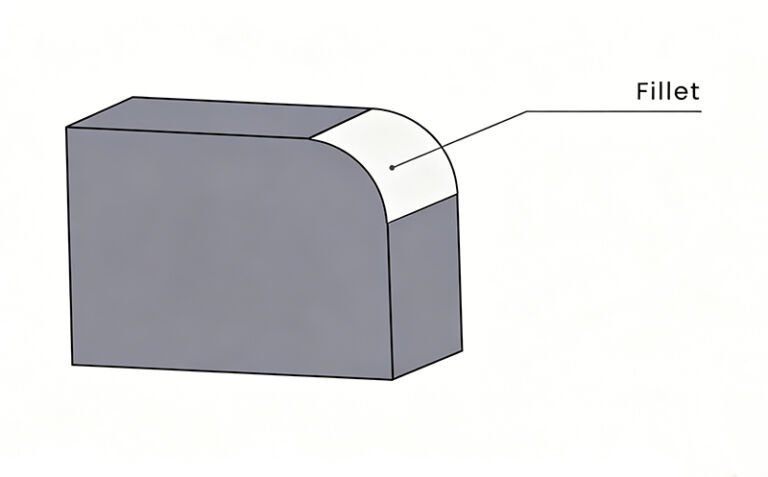
A fillet refers to a smooth curved transition between two intersecting surfaces; it can be located on the inner or outer side of a part. The primary function of a fillet is to reduce stress concentration at sharp corners, thereby enhancing the stability and durability of load-bearing structures. At the same time, fillets improve the assembly and user experience: during assembly, the edges are smoother and less likely to catch, and they also reduce the risk of bumps and scratches caused by sharp edges. Furthermore, fillets create a more natural transition and contribute to a more harmonious and aesthetically pleasing appearance of the part.
Ⅲ. Advantages and Disadvantages of Fillet
Advantages
- Less prone to cracking and deformation (Impact resistance):
When sharp right angles are subjected to force, pressure tends to concentrate at the corners, making them prone to cracking or deformation. Rounded corners distribute the force more evenly, thereby making the structure more stable.
- Durability (Fatigue Resistance):
Under repeated vibration or frequent use (such as machine operation or the repeated opening and closing of parts), sharp corners are more prone to developing cracks over time. Rounded corners provide a smoother transition, reducing this long-term damage and making parts more durable.
- Enhanced Safety:
Rounded corners have no sharp edges, reducing the risk of cuts to hands during handling or assembly and making operations safer.
- Smoother Fluid Flow and Casting:
Using rounded corners in water or air flow channels allows for smoother flow, reducing resistance and turbulence; during the casting process, rounded corners also allow molten metal to flow more evenly, making it less prone to porosity or cracking after cooling.
Disadvantages
- High processing costs and difficulty:
Creating precise arcs requires specialized cutting tools, involves multiple processing steps, and takes a long time, resulting in significantly higher costs than chamfering.
2. Inconvenient in space-constrained areas:
In very compact structures, fillets may interfere with assembly or take up valuable space.
Ⅳ. What Is a Chamfer?
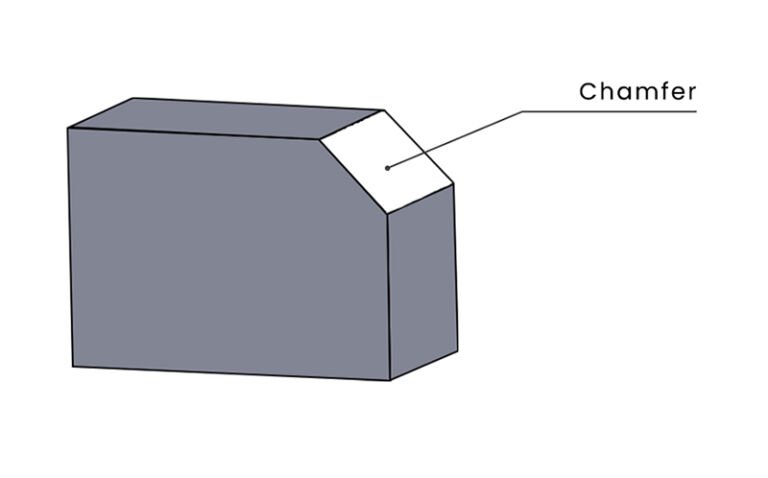
A chamfer is a process in which sharp edges and right angles on a part are machined into a sloped surface to replace the original sharp edges. It is very common in CNC machining, with a 45° chamfer being the most frequently used; however, other angles (such as 30° or 60°) can also be machined as needed. Chamfers can be applied to the outer surfaces of parts as well as to internal features such as holes and slots.
The purpose of chamfering is to remove burrs created during machining and prevent sharp edges from injuring hands or damaging other components. During assembly, it also serves as a guide, making it easier to align and install shaft and hole-type parts. Additionally, it improves the overall appearance of the part.
Ⅴ. Advantages and Disadvantages of Chamfer
Advantages
- Easy to machine and low cost:
Chamfering is simple to perform; it can be completed with a single bevel cut, requiring minimal time. Universal chamfering tools can accommodate bevels of various sizes without the need to change specialized cutting tools, effectively controlling both processing costs and labor hours.
- Basic Crack Prevention and Aesthetic Appeal:
Chamfering slightly alleviates stress at right angles, preventing the cracking issues common with sharp corners; the clean beveled surface also enhances the part’s appearance, providing a decorative effect.
- Strong Assembly Guidance:
The beveled surface acts as a “guide groove,” making it easier to align parts such as shafts and holes during assembly. It prevents parts from getting stuck at right angles, thereby increasing assembly speed.
- Lighter Weight and Higher Material Utilization:
Chamfering removes material from the edges through beveling, reducing part weight while maintaining the same structure. In contrast, rounding retains more material, so chamfering offers a clear advantage in applications where weight reduction is critical.
Disadvantages
- Concentrated stress, prone to cracking:
A chamfer is simply a slanted surface and cannot distribute stress as effectively as a fillet; pressure tends to concentrate at the edges. Under prolonged stress or vibration, cracks or deformation are more likely to occur.
- Limited load-bearing capacity:
In structures requiring high load-bearing capacity or long-term use, chamfers provide weaker reinforcement at connection points, resulting in overall stability that is inferior to fillets.
- Safety hazards during operation:
The sharp edges can easily cut hands. Although they are less sharp than right angles, the beveled edges remain sharp, and careless handling during transportation or assembly can result in skin lacerations.
- Poor performance with fluids and casting:
Fluids flowing over bevels are prone to turbulence, reducing flow efficiency; during casting, molten metal flows unevenly, leading to issues such as uneven filling and internal porosity.
Ⅵ. Differences between Chamfer and Fillet
| Comparison Criteria | Chamfer | Fillet |
|---|---|---|
Basic Geometry |
A flat bevel is formed by beveling the right-angle corner, retaining a subtle angular edge. |
The right-angle corner is transitioned with a smooth curved arc, resulting in fully rounded edges free of sharp corners. |
Machining Difficulty |
Low, completed in a single beveling pass. |
High, requiring precise control of the arc contour. |
Machining Cost |
Relatively low, with high production efficiency. |
Relatively high, with long processing cycle time and high tooling costs. |
Tooling Requirements |
Universal chamfer tools, compatible with a wide range of dimensions. |
Dedicated form tools, must be matched to the specified arc radius. |
Stress Distribution |
Mitigates stress concentration, but with limited effectiveness. |
Uniformly distributes stress, eliminating excessive localized loading. |
Fatigue Resistance |
Moderate, prone to crack initiation under long-term cyclic loading. |
Excellent, significantly prolongs the fatigue life of components. |
Operational Safety |
Edges retain a certain degree of sharpness, requiring proper protective measures. |
Smooth edges prevent scratches/lacerations during handling and assembly, offering superior operational safety. |
Core Advantages |
Excellent assembly alignment, strong decorative/aesthetic appeal, and controllable costs. |
High structural strength, resistance to deformation and cracking, and high safety factor. |
Application Scenarios |
1. Shaft-hole fit and assembly guidance applications;
2. General hardware and furniture accessories;
3. Scenarios prioritizing low cost and high efficiency. |
1. High-load components;
2. Core structures of precision equipment/machinery;
3. Scenarios with stringent safety requirements. |
Ⅶ. How to Determine Whether to Use a Fillet or a Chamfer?
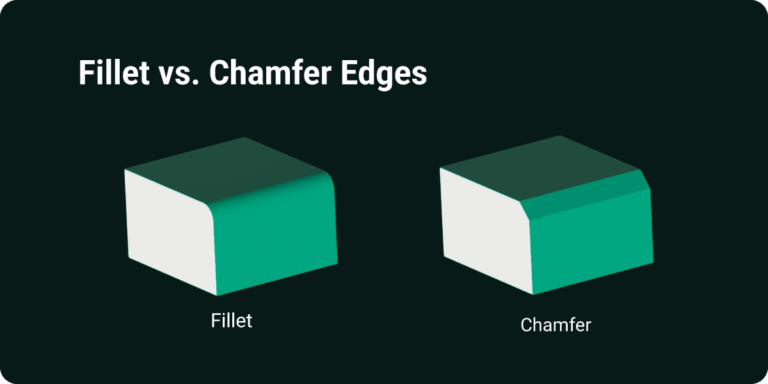
Now that we understand the characteristics and advantages of fillets and chamfers, we can make a clearer decision on which edge treatment to choose based on specific application scenarios.
- Situations where fillets are appropriate:
Parts that must withstand heavy loads or significant pressure: Fillets can effectively reduce stress concentration and enhance the structural strength of parts—a benefit that chamfers cannot replicate.
- Parts intended for display or with high aesthetic requirements: The curved transition of a fillet is softer and more refined, offering a superior visual appearance. It is suitable for parts intended for public display or where aesthetics are a priority.
- Performance requirements take precedence over manufacturing costs: While fillets are more expensive to produce and involve more complex processes, they are the more reasonable choice if the part requires fillets to achieve the necessary strength and durability.
2. Situations where chamfers are appropriate:
- When parts are subjected only to light pressure and do not require high-strength load-bearing or impact resistance, chamfers are entirely sufficient.
- When parts need to be assembled with other components: Chamfering mating surfaces such as pins, bolts, and shaft holes provides guidance, ensuring smoother alignment and installation between parts.
- When cost and machining efficiency are high priorities: Chamfering is simpler to machine, requiring only a single pass with standard cutting tools, resulting in lower costs; in situations where the special properties of rounded corners are not required, chamfering is the more economical choice.
Understanding the appropriate applications for these two edge finishing methods helps us make more informed decisions during design and manufacturing. There is no absolute superiority between fillets and chamfers; the final choice ultimately depends on the part’s actual function and usage requirements.
KEYWIN can provide professional planning and design for fillet and chamfer selection based on your product’s functionality and machining requirements, offering full support from prototyping to mass production. Please feel free to contact us for customization.
Ⅷ. Summary
Chamfering is simple and efficient, facilitating assembly alignment and burr removal, and is suitable for parts subjected to low stress and designed primarily for basic functions. Filleting, on the other hand, distributes stress, reduces damage caused by vibration, is less prone to fracture, and provides safer edges; however, it is relatively more complex to machine and involves higher costs.
In practical machining design, you can flexibly choose between the two based on load requirements, cost budgets, and application scenarios. You can also combine both to strike a balance between manufacturability, aesthetics, strength, and safety.
Want to precisely control CNC chamfering and rounding processes while balancing part performance and cost? KEYWIN offers professional, end-to-end CNC machining services that can be customized to your needs, handling everything from prototyping to mass production. Visit our official website to request a personalized quote!
Ⅸ. FAQ
- Are chamfers, tapers, and bevels the same thing?
A: No.
Chamfer: Used for edge finishing to facilitate assembly and deburring.
Taper: Modifies the overall shape for sealing and positioning.
Bevel: A groove prepared before welding to increase the weld contact area.
- Are fillets really stronger and more durable than chamfers? In what situations must fillets be used?
A: Yes, fillets offer superior structural strength. They distribute stress evenly, preventing stress concentration at sharp corners, and significantly improve a part’s load-bearing capacity and fatigue life. They are particularly suitable for core components subjected to heavy loads, repetitive vibrations, or cyclic loads (such as gears, mechanical brackets, and structural components of high-precision equipment). If a part has strict requirements for durability and crack resistance, fillets are the more reliable choice.
- How can one quickly determine whether to use a fillet or a chamfer during design?
A: You can make a quick decision based on these three key factors:
Load requirements: High load, high fatigue resistance → Choose a fillet; light load, no repetitive stress → A chamfer may be selected.
Assembly requirements: Shafts, holes, bolts, etc., requiring mating and alignment → Choose chamfers for guidance; no assembly requirements → Select based on strength or appearance.
Cost efficiency: Aiming for low cost and fast machining → Choose chamfers; prioritizing structural strength and long-term durability → Choose fillets.
If budget and manufacturing processes permit, fillets can be used in core stress zones and chamfers in non-critical areas to balance performance and cost. Contact us to build a customized solution exclusively for you!