Ⅰ. Introduction
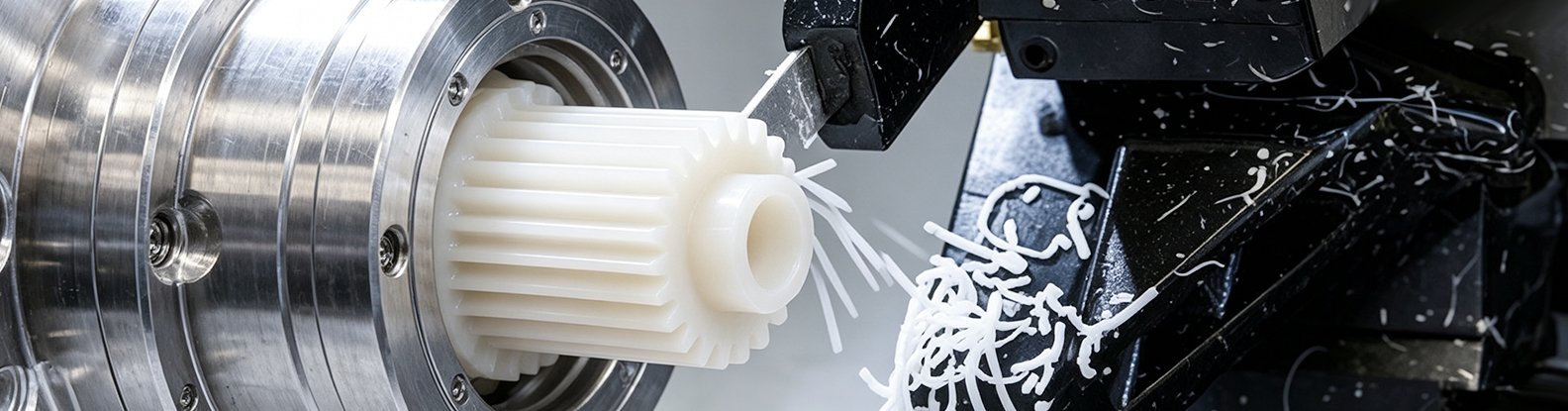
A bearing housing in PA6/6 hits spec on day one, then measures 0.08mm oversized after sitting in a humid warehouse for three days. No one changed the CAD. No one changed the process. The material absorbed moisture and grew — and now the assembly doesn’t fit. This is the defining problem with nylon for machining: the physics of the material punish shops that treat it like aluminum.
For engineers sourcing precision plastic components for medical devices, automotive assemblies, or robotics end-effectors, dimensional instability is not a cosmetic concern. It is a functional failure mode. The supplier who understands nylon dimensional stability at the process level — not just the material data sheet — is the one who ships parts that still measure correctly when they reach your floor.
Ⅱ. Nylon Dimensional Stability Reference by Application
| Property | Nylon 6 | Nylon 6/6 | Nylon 6/6 + 30% GF |
|---|---|---|---|
Moisture absorption (24h) |
~3.5% |
~3.0% |
~1.2% |
Dimensional change / 1% moisture |
~0.15–0.20mm/100mm |
~0.10–0.15mm/100mm |
~0.05mm/100mm |
Typical CNC tolerance (dry) |
±0.05mm |
±0.03mm |
±0.015mm |
Post-absorption tolerance risk |
High |
Moderate |
Low |
Best Application |
General structural |
Precision Mechanical |
High-precision or humid environments |
Recommended pre-machine conditioning |
24–48h at 23°C / 50% RH |
24–48h at 23°C / 50% RH |
12–24h minimum |
Note: All tolerances above reflect dry, freshly machined state. Final tolerance spec for shipped parts must account for end-use humidity exposure.
Ⅲ. Why Nylon Moves: The Moisture Mechanism
Polyamide polymers are hygroscopic by structure — the amide group in the backbone absorbs water molecules, which act as a plasticizer between polymer chains. This is not surface contamination. It is molecular-level uptake that increases chain mobility and causes the bulk material to swell.
Nylon 6/6 absorbs roughly 3% of its weight in moisture under standard ambient conditions. On a 100mm diameter bore, that can translate to a diameter increase of 0.10–0.15mm — enough to fail an H7/f7 fit entirely.
The problem compounds when raw stock arrives from a distributor with unknown moisture history. Machining wet nylon generates poor surface finish, increases tool deflection, and produces parts that will dimensionally shift further as they dry or re-humidify in service.
Engineering Heuristic: Before any precision CNC nylon parts run, condition raw stock at controlled temperature and humidity for a minimum of 24 hours. Weigh the stock before and after to confirm stable moisture content. If weight stabilizes, you are machining a predictable material. If it keeps changing, you have a bad stock lot.
Ⅳ. Tooling and Cutting Parameters for Machining Nylon 6/6
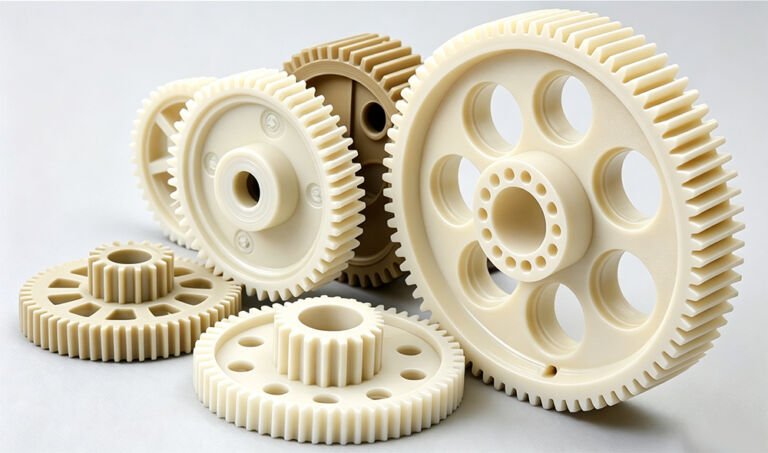
Machining nylon 6/6 is not a slower, lighter version of aluminum work. Nylon’s thermal conductivity is roughly 0.25 W/m·K — compared to 160 W/m·K for 6061 aluminum — so cutting heat stays in the part instead of conducting away. Localized thermal distortion follows.
Sharp, high-rake HSS or uncoated carbide tooling is standard — coated carbide built for metals causes material adhesion on the flank face. Rake angles of 15–20° clear chips aggressively and reduce heat buildup.
Depth of cut below 0.5mm for finishing passes reduces surface temperature at the tool-chip interface.
Coolant choice matters more than most shops acknowledge. Compressed air or mist coolant is preferred over flood coolant — water-based coolants introduce moisture directly into an already hygroscopic part during cutting, which defeats pre-conditioning entirely.
Pro Tip: Run a dry finish pass on critical-tolerance features. After roughing with air blast, switch off coolant entirely for the final 0.1–0.2mm stock removal. This gives you the cleanest, most stable surface for inspection.
Ⅴ. Fixturing and Thermal Management During CNC Operations
Nylon’s coefficient of thermal expansion (CTE) is approximately 80 µm/m·°C — roughly four times higher than aluminum. On a part that heats 20°C during machining, a 50mm feature can grow by 0.08mm before it ever reaches the CMM.
Clamping forces present a secondary problem. Over-clamped nylon deforms elastically during machining and springs back after release, producing out-of-tolerance features even when the in-process measurement looked correct. Fixtures should distribute load over the largest possible contact area — soft jaws over standard vise jaws.
For medical or robotics-grade parts where tolerances are at or below ±0.02mm, the part should stabilize at room temperature — typically 15–20 minutes — before any inspection measurement is taken. A freshly cut surface at elevated temperature will not give you a reliable number.
Engineering Heuristic: Measure nylon parts at the same ambient temperature at which they will be used. A part measured at 22°C that will operate at 35°C will be dimensionally different at both conditions. For thermally exposed applications, spec your tolerance at the operating temperature, not room temperature.
Ⅵ. Glass-Filled Nylon: When Standard PA6/6 Is Not Enough
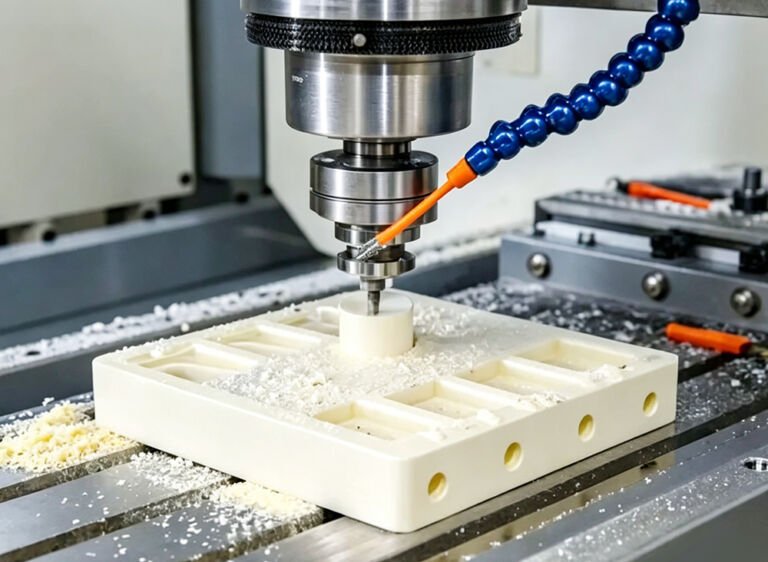
30% glass-fiber-reinforced nylon (PA6/6 GF30) reduces moisture absorption by roughly 60% relative to unfilled grade. Dimensional change per unit moisture absorption drops proportionally. For parts that must hold ±0.01mm or tighter over their service life in variable humidity environments, GF30 is often the only viable path without switching to a fundamentally different polymer such as PEEK or Delrin (POM).
The trade-off is machinability. Glass fiber is abrasive — tool wear accelerates 3–5× compared to unfilled nylon, and carbide tooling with TiAlN or diamond coating is justified on high-volume runs. Ra values below 0.8 µm are difficult to achieve without grinding as a secondary operation.
Against these costs, GF30 offers tensile strength approaching 190 MPa and a heat deflection temperature above 250°C under load — competitive with some aluminum alloys in specific structural applications.
Pro Tip: If the end-use environment is dry and controlled (sealed enclosure, climate-controlled lab), unfilled PA6/6 is usually adequate. GF30 is worth the tooling cost when the part will see >60% RH or temperature cycling above 60°C.
Ⅶ. Design Checks Before You Send Your Files
The most common source of tolerance failures on plastic CNC machining services jobs is not the machining — it is the design. Run through these checks before uploading your CAD.
| Check | Minimum Requirement | Failure Mode if Ignored |
|---|---|---|
Wall Thickness Uniformity |
≥2mm, <3:1 thickness ratio |
Warping during or after machining |
Tight-tolerance bore diameter |
Specify as dry, conditioned |
Moisture-induced oversize in service |
Thread Specification |
Specify minor/major diameter tolerances explicitly |
Interference fit failures post-humidity |
Feature proximity to clamp zones |
≥5mm from fixturing surfaces |
Deformation artifact in final dimension |
Surface Finish Requirement |
Specify Ra in µm, not qualitative terms |
Inconsistent measurement across suppliers |
Material Certification Requirement |
Call out if MIL, RoHS, FDA-grade required |
Wrong Grade Shipped |
Tolerance vs. operating temperature |
Spec at service temp, not room temp |
Out-of-spec in assembly |
Keywin’s DFM review process flags all of the above at the quoting stage — upload your CAD file and the feedback comes back alongside the quote.
Ⅷ. FAQ
1.What is the tightest tolerance achievable on CNC-machined nylon parts?
A: On properly conditioned, unfilled PA6/6, tolerances of ±0.02–0.03mm are achievable under controlled shop conditions. Glass-filled nylon (GF30) can hold ±0.01mm on linear dimensions with correct tooling and thermal management. Keywin’s machining centers hold ±0.005mm on metals; on nylon, actual achievable tolerance depends heavily on part geometry and moisture conditioning protocol.
2. What is the difference between nylon 6 and nylon 6/6 for machining applications?
A: Nylon 6 has a lower melting point (~220°C) and higher moisture absorption (~3.5%) than nylon 6/6 (~255°C melt, ~3.0% absorption). For precision parts, PA6/6 is preferred because it is dimensionally more stable and holds tighter tolerances. Nylon 6 is more cost-effective for non-critical structural shapes.
3. Does coolant cause dimensional problems when machining nylon?
A: Yes. Water-based flood coolant introduces moisture into nylon during cutting, partially reversing the effect of pre-conditioning. For tight-tolerance work, use compressed air blast or minimal mist coolant. If flood coolant is unavoidable due to heat management requirements, allow the part to re-condition at controlled humidity for 24 hours before final inspection.
4. How does nylon compare to Delrin (POM) for precision machining?
A: Delrin (POM-C) absorbs roughly 0.2% moisture versus 3.0% for PA6/6 — dimensionally more stable wherever ambient humidity varies. Nylon’s advantage is higher fatigue resistance and impact strength, making it the better choice for wear surfaces under cyclic load. For precise fits in uncontrolled humidity, POM is usually the safer selection.
5. What certifications should a supplier have for nylon parts going into automotive or medical assemblies?
A: At minimum, ISO 9001 for general quality systems; for automotive programs, IATF 16949 is required under most Tier 1 and OEM supplier requirements. Medical applications demand documented 100% inspection protocols and CMM traceability. Keywin holds both certifications, with CMM accuracy to 0.001mm and full inspection data recorded per batch.
6. Can nylon parts be anodized or plated for surface protection?
A: Nylon cannot be anodized — that process is specific to aluminum. Electroplating is technically possible on nylon with a conductive surface pretreatment, but it is uncommon and rarely the right solution. More practical options for nylon include laser marking for part identification, dry film lubricant coatings for wear surfaces, and moisture-barrier sealing for dimensional stability in high-humidity applications.
7. What is a reasonable lead time for prototype CNC nylon parts?
A: For standard geometries with tolerances at or above ±0.05mm, 7-day OEM prototype delivery is achievable. Parts requiring tighter tolerance with full CMM inspection take slightly longer due to conditioning and measurement cycles.
Keywin‘s 7-day OEM prototyping and 3-day CNC drilling lead times apply to both metal and plastic part runs, providing a fast validation path for NPI programs.
Getting nylon right the first time requires a supplier who treats it as a distinct material category — not a softer version of a metal job. Keywin’s 23-year track record across 80+ CNC machines, ISO 9001/IATF 16949 certification, and 100% batch inspection protocol gives engineers in medical, automotive, and robotics programs the documented process control they need to validate a new material run with confidence.
Upload your CAD file at keywinmfg.com quote for a DFM review and instant quote.