Most material selection debates between titanium and aluminum are settled by one of three facts: aluminum has no fatigue limit, titanium costs up to ten times as much to machine, and the two metals cannot touch each other in a wet assembly without galvanic corrosion eating the aluminum. Everything else — density, tensile strength, thermal conductivity — is secondary, because once you know the operating loads, environment and budget, the choice is usually obvious.
This guide is written for engineers and sourcing teams who need to specify one of the two for a CNC machined part. It skips the generic property recap that fills most comparison articles and focuses on the decisions that actually change the outcome: when fatigue rules out aluminum, when titanium is a waste of money, how machining parameters differ, and how to evaluate total cost rather than just raw material price.
Ⅰ. Key Properties at a Glance
The table below covers the numbers referenced most often in material selection. Specific alloy grades matter more than generic metal averages, so the most common CNC grades are listed alongside.
| Property | Titanium (Ti-6Al-4V / Grade 5) | Aluminum (6061-T6 / 7075-T6) |
|---|---|---|
| Density | 4.43 g/cm³ | 2.70 g/cm³ |
| Tensile strength | ~950 MPa | ~310 MPa (6061) / ~572 MPa (7075) |
| Strength-to-weight ratio | ~214 kN·m/kg | ~115 (6061) / ~212 (7075) kN·m/kg |
| Elastic modulus | ~114 GPa | ~69 GPa (6061) / ~72 GPa (7075) |
| Thermal conductivity | 6.7 W/m·K | 167 W/m·K (6061) |
| Melting point | 1660 °C | 582–652 °C (alloy range) |
| Max service temperature | 400–550 °C | 150–250 °C (strength drops above 150 °C) |
| Thermal expansion | 8.6 × 10⁻⁶ /°C | 23.6 × 10⁻⁶ /°C (6061) |
| Fatigue limit | Yes (>500 MPa for Ti-6Al-4V) | No defined fatigue limit |
| Corrosion resistance | Self-healing TiO₂ layer; immune to seawater and most acids | Al₂O₃ layer; pitting in chloride environments |
| Crystal structure | HCP | FCC |
Titanium is roughly 66% denser than aluminum but 2–3× stronger in common CNC alloys. The strength-to-weight ratio of Ti-6Al-4V (~214 kN·m/kg) is comparable to 7075-T6 (~212) and nearly double 6061-T6 (~115) — but the real advantage shows up under cyclic load and high temperature, not in static strength comparisons.
Ⅱ. Mechanical Properties: Strength, Fatigue, and Stiffness
Static strength-to-weight ratio is the comparison most articles stop at, and it is the least useful one for real selection. The number that actually decides whether titanium is required is the fatigue limit.
Titanium has a defined fatigue limit — above roughly 500 MPa for Ti-6Al-4V, the S-N curve flattens. If the cyclic stress stays below that threshold, the part will not fail from fatigue regardless of cycle count. Aluminum has no fatigue limit. Its S-N curve keeps falling, so under cyclic loading the part will eventually fail; the only question is when.
This has a direct selection consequence:
- Static load, short life or low cycles → aluminum is usually sufficient. A bracket, a housing, a fixture — 6061 or 7075 handles the load and costs a fraction of titanium.
- Cyclic load, long design life → titanium is often the only safe choice. Aircraft landing gear components, engine mounts, medical implants and high-cycle valve springs live here. Using aluminum means designing to a finite life and accepting replacement intervals.
- Cyclic load, short life → aluminum may work if the design life is short enough and inspection is possible.
Why Tensile Strength Cannot Substitute for Fatigue Performance
A common error is to see 7075-T6 at ~572 MPa approaching Ti-6Al-4V at ~950 MPa and conclude “aluminum will do.” Under static load, maybe. Under cyclic load, it fails — the two metals have differently shaped S-N curves. Titanium has a fatigue limit (~500 MPa): below it, the part will not fail from fatigue no matter the cycle count. Aluminum has no plateau; its S-N curve keeps declining, so an aluminum part under cyclic load will inevitably fail — the only question is when.
At 10⁷ cycles, 7075-T6 fatigues at ~150–280 MPa while Ti-6Al-4V holds above 500 MPa — an order-of-magnitude gap, not a marginal one. Selection implication: for static load (brackets, housings), tensile strength is a valid metric. For cyclic load (rotating shafts, vibrating structures), you must use fatigue strength — and titanium is often the only safe choice.
Elastic Modulus and Stiffness-Driven Design
Titanium’s modulus (~114 GPa) is roughly 60% higher than aluminum’s (~69 GPa). This matters for “stiffness-driven” parts — those whose limit is deflection, not breaking (e.g., precision-instrument beams, long shafts). Because titanium is stiffer, less material is needed to meet the same deflection limit, which can offset its 66% higher density — a titanium part can end up no heavier than an aluminum one, sometimes lighter.
For “strength-driven” parts (core requirement is not breaking), the modulus advantage matters less; strength-to-weight ratio is the primary metric.
Corrosion Resistance
Both metals form protective oxide layers, but the layers behave very differently.
Titanium’s TiO₂ layer is self-healing. If scratched, it reforms instantly in the presence of oxygen. This makes titanium effectively immune to seawater, chlorides, oxidizing acids and most industrial chemicals. It is the default choice for marine fasteners, chemical processing equipment and surgical implants.
Aluminum’s Al₂O₃ layer is stable in neutral pH but breaks down in chloride environments (coastal, marine, de-icing) and in alkaline conditions. Pitting corrosion is the most common failure mode. Anodizing improves resistance but does not make aluminum suitable for sustained seawater immersion.
Galvanic corrosion: risk of dissimilar metal contact. When titanium and aluminum are in direct contact in the presence of an electrolyte (water, salt spray, humidity), titanium acts as the cathode and aluminum as the anode. The aluminum corrodes preferentially — often aggressively. This is galvanic corrosion, and it is one of the most common causes of premature failure in mixed-metal assemblies.
Design rules when the two metals must coexist:
- Electrically isolate the contact surfaces with insulating gaskets (PTFE, nylon, composite washers) and use isolating bushings on fasteners.
- Avoid titanium fasteners in aluminum structure unless isolated — the small anode area (aluminum) relative to the large cathode (titanium fastener) concentrates corrosion.
- Paint or coat the aluminum even if isolated — the coating reduces the cathode-to-anode area ratio.
- In seawater, do not mix them at all without full isolation. The electrolyte is too conductive.
If the assembly cannot accommodate isolation, select metals closer on the galvanic series — aluminum with stainless steel is less aggressive than aluminum with titanium.
Thermal Behavior: Conductivity vs Heat Resistance
Thermal conductivity and temperature resistance push in opposite directions, which is why heat management applications rarely use titanium and high-temperature applications rarely use aluminum.
Aluminum conducts heat at 167–235 W/m·K depending on alloy — roughly 10× titanium. This is why aluminum is the default for heat sinks, heat exchangers, LED housings, cold plates and any part whose job is to move heat. Titanium’s low conductivity (6.7–22 W/m·K) makes it a thermal insulator by comparison.
Titanium retains strength at elevated temperature. Ti-6Al-4V holds useful strength to 400 °C and higher-grade titanium alloys reach 550 °C. Aluminum alloys begin losing strength above 150 °C and are generally not used above 250 °C. For exhaust components, engine-adjacent parts and high-temperature structural applications, titanium is the viable option.
Thermal expansion also differs. Aluminum expands at 23.6 × 10⁻⁶ /°C, roughly 2.7× titanium’s 8.6 × 10⁻⁶ /°C. In precision assemblies with tight running fits, this matters: an aluminum housing around a steel or titanium shaft will lose interference fit at elevated temperature, while a titanium housing will hold it.
Ⅲ. CNC Machining: Titanium vs Aluminum
This is the section most comparison articles skip, and it is where the biggest cost and lead-time differences live.
Machinability Overview
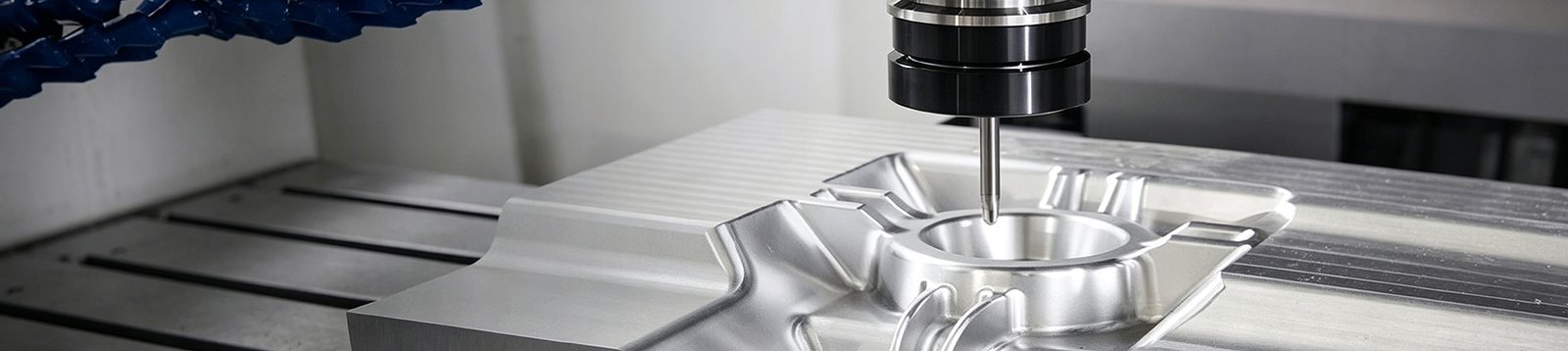
Aluminum is one of the easiest metals to machine. It cuts clean, allows high spindle speeds and fast feeds, transfers heat into the chips rather than the tool, and produces minimal tool wear. Most CNC shops treat aluminum as a high-throughput material.
Titanium is at the opposite end. Its low thermal conductivity means heat concentrates at the cutting edge instead of leaving with the chip. Its high chemical reactivity at cutting temperature causes galling and built-up edge on standard tooling. Its high strength means cutting forces are high. The result is slow machining, short tool life and a per-part cost that can reach 10× aluminum for equivalent geometry.
Machining Parameter Comparison
| Parameter | Aluminum (6061 / 7075) | Titanium (Ti-6Al-4V) |
|---|---|---|
| Spindle speed | 8,000–15,000 RPM | 300–1,000 RPM |
| Feed rate | 0.05–0.25 mm/tooth | 0.05–0.10 mm/tooth |
| Cutting speed (SFM) | 600–1,200 SFM | 40–60 SFM |
| Depth of cut (roughing) | 2–10 mm | 0.5–2 mm |
| Tooling | Coated carbide, polished | Sharp carbide, PCD limited use; avoid TiAlN |
| Coolant | Flood or air blast; often optional | High-pressure coolant (70+ bar) strongly recommended |
| Chip control | Easy, breaks clean | Tough, stringy; requires chip control geometry |
| Tool life per edge | Long (hundreds of parts) | Short (tens of parts, sometimes fewer) |
The speed difference alone — 600 SFM vs 40 SFM — means a titanium part takes roughly 15× longer to cut than the same geometry in aluminum, before accounting for tool changes and slower roughing depths.
Machining Challenges Specific to Titanium
- Heat concentration: Low thermal conductivity (6.7 W/m·K) means heat stays in the cut zone. Without high-pressure coolant, the cutting edge exceeds 600 °C and softens rapidly.
- Galling and built-up edge: Titanium welds to cutting edges at temperature. Sharp, positive-rake geometry and appropriate coatings (uncoated carbide or TiAlN-avoided coatings) reduce this.
- Springback and deflection: Titanium’s low elastic modulus relative to its strength means the material springs back after the tool passes. This causes dimensional drift and rubs the tool flank, accelerating wear.
- Work hardening: The surface hardens during cutting, so a second pass at the same depth is harder than the first. Climb milling and consistent depth of cut help.
Tolerance and Surface Finish Capability
Both metals can hold tight tolerances on a capable CNC, but the effort differs:
| Tolerance | Aluminum | Titanium |
|---|---|---|
| ±0.05 mm | Routine | Routine |
| ±0.025 mm | Standard | Achievable, slower |
| ±0.01 mm | Achievable with temperature control | Difficult; requires rigid setup and multiple finish passes |
| Surface finish Ra | 0.8–1.6 μm standard, 0.4 μm with finishing | 0.8–1.6 μm standard; mirror finish requires specialized process |
Ⅳ. Surface Treatment Options
Surface treatment affects not only appearance and corrosion resistance but also final tolerance — some coatings (e.g., hardcoat anodizing) change dimensions by 25–50 μm, which must be accounted for at the design stage. CNC parts and 3D-printed parts start from different places: CNC parts already have a low surface roughness (Ra 0.8–1.6 μm), so treatment is for decoration or corrosion; 3D-printed parts have a rough surface (Ra 5–15 μm) and typically require blasting or machined-face finishing before entering the same treatment workflow as CNC parts.
| Treatment | Aluminum | Titanium |
|---|---|---|
| Anodizing (Type II) | Standard; decorative + corrosion | Not applicable |
| Hardcoat anodizing (Type III) | High wear resistance; mind dimensional growth | Not applicable |
| Passivation | Not typical | Standard; enhances TiO₂ layer |
| PVD / DLC coating | Possible | Common for wear and medical parts |
| Powder coating | Common | Less common; adhesion requires prep |
| Electropolishing | Limited | Common for medical and aerospace |
| Blasting (for 3D-printed parts) | Standard post-processing | Standard post-processing |
Design note: Aluminum anodizing changes dimensions (Type II ~5–15 μm, Type III up to 25–50 μm), so mating faces must specify “before anodizing” or “after anodizing” tolerances on the drawing. Titanium passivation does not change dimensions, but PVD/DLC coatings (2–5 μm) require allowance on mating faces.
Ⅴ. Cost: Raw Material, Machining, and Total Ownership
Cost is where most selection decisions actually get made, and it is also where the most common mistake happens — comparing only raw material price.
Raw Material Cost
Titanium raw material costs roughly 2.5× aluminum per kilogram. But titanium is denser, so a part of identical volume uses 66% more mass, widening the gap. For a part of the same geometry, titanium material cost is roughly 4× aluminum.
Machining Cost Comparison
This is the larger factor. Because titanium machines 10–15× slower, consumes tools faster and requires high-pressure coolant and rigid setups, the per-part machining cost can reach 10× the aluminum equivalent for the same geometry. For complex parts with deep pockets or thin walls, the ratio is worse.
Total Cost of Ownership
The number that matters for long-life or hard-to-service parts is not the purchase price but the cost over the part’s life. A simple illustration:
| Scenario | Aluminum Part | Titanium Part |
|---|---|---|
| Initial cost | $100 | $400 |
| Service life (cyclic load, marine environment) | 2 years before replacement | 20+ years |
| Replacements over 20 years | 10 | 0 |
| 20-year total | $1,000 + downtime | $400 |
For a static, dry, short-life part, aluminum wins on every axis. For a cyclic-loaded, corrosion-exposed, hard-to-replace part, titanium’s higher upfront cost is recovered within the first replacement cycle.
Ⅵ. Applications: Where Each Metal Wins
| Application | Recommended metal | Reason |
|---|---|---|
| Aircraft structural frames | Aluminum (7075) | High strength-to-cost, static-dominant loads |
| Aircraft engine mounts, landing gear | Titanium | Fatigue limit + temperature resistance |
| Medical implants (orthopedic, dental) | Titanium | Biocompatibility, fatigue limit, corrosion immunity |
| Marine fasteners, propeller shafts | Titanium | Seawater corrosion immunity |
| Heat sinks, LED housings, cold plates | Aluminum | Thermal conductivity 10× titanium |
| Consumer electronics housings | Aluminum | Cost, anodizing options, machinability |
| High-performance automotive (valves, rods) | Titanium | Weight + fatigue + temperature |
| Bicycle frames (performance) | Titanium | Fatigue limit, ride quality, corrosion immunity |
| Bicycle frames (mass market) | Aluminum | Cost |
| Chemical processing vessels | Titanium | Acid immunity |
| Packaging, architectural, consumer goods | Aluminum | Cost, formability, recyclability |
A common strategy in mixed assemblies is to use titanium where the part sees load or corrosion and aluminum elsewhere — the airframe of a jet is mostly aluminum, while the engine and landing gear are titanium. This balances cost and performance at the system level.
Where titanium is wasted.
Titanium is often specified for reasons that do not justify the cost: perceived premium quality, marketing appeal, or “just to be safe.” If the part sees static load, is protected from corrosion, and operates near ambient temperature, 7075 aluminum will usually match the performance at a fraction of the cost. A DFM review is the right place to catch this before the material is locked into the drawing.
Ⅶ. Titanium vs Aluminum Selection Checklist
Use this to reach a go/no-go decision before specifying either material.
| Question | If yes → | If no → |
|---|---|---|
| Does the part see cyclic (fatigue) loading over a long design life (>10⁵ cycles)? | Titanium | Continue |
| Is the operating temperature above 150 °C? | Titanium | Continue |
| Will the part be exposed to seawater, chlorides or oxidizing acids? | Titanium | Continue |
| Is the part a medical implant or in-body device? | Titanium | Continue |
| Is the part a heat-transfer component (heat sink, heat exchanger)? | Aluminum | Continue |
| Is the part a consumer electronic housing or decorative part? | Aluminum | Continue |
| Is the part produced in high volume with tight cost pressure? | Aluminum (unless loads force titanium) | Continue |
| Will the part be welded, bent or deep-drawn? | Aluminum (titanium is difficult to weld and form) | Continue |
| Is the part in a static-load, dry, ambient environment? | Aluminum | Continue |
| Are titanium and aluminum both present in the same assembly? | Add galvanic isolation or reconsider material | — |
If the checklist leaves the answer ambiguous, the deciding factor is usually fatigue. If the part sees any cyclic load and the design life is long, default to titanium. If the load is static, default to aluminum and spend the savings elsewhere.
Conclusion
Titanium and aluminum each have a clear role in CNC machined part design. Aluminum is the default for cost-driven, static-load, thermally active or high-volume parts. Titanium is the answer when fatigue life, corrosion immunity, biocompatibility or high-temperature strength are real requirements — not preferences. The most expensive mistake is not choosing the wrong metal, but choosing titanium where 7075 would do the job, or choosing aluminum where cyclic load will guarantee a fatigue failure.
If you are specifying a part and want a second opinion on whether titanium is actually required — or whether an aluminum alloy would meet the requirement at lower cost — upload your drawing for a DFM review. If the material choice is settled, get an instant quote for CNC machined titanium or aluminum parts and compare the real cost before committing to the drawing.
FAQ
1. Is titanium stronger than aluminum?
Yes. Ti-6Al-4V reaches ~950 MPa tensile strength, compared with ~310 MPa for 6061-T6 and ~572 MPa for 7075-T6. Titanium also retains strength at higher temperatures and under cyclic loading, where aluminum has no fatigue limit.
2. Is titanium lighter than aluminum?
No. Titanium is roughly 66% denser than aluminum (4.43 g/cm³ vs 2.70 g/cm³). However, titanium’s higher strength means less material is often needed, so a titanium part can be lighter than an aluminum part designed for the same load.
3. Can titanium and aluminum be used together?
Yes, but only with electrical isolation. In contact with an electrolyte, titanium causes galvanic corrosion of aluminum. Use insulating gaskets, bushings and coated fasteners. In sustained seawater exposure, avoid the combination entirely.
4. Which is better for CNC machining?
Aluminum is far easier and cheaper to machine — higher speeds, longer tool life, lower coolant demand. Titanium machines slowly, consumes tools quickly and requires high-pressure coolant. The choice should follow the engineering requirement, not the machining preference.
5. Why is titanium so expensive to machine?
Three reasons: low thermal conductivity concentrates heat at the cutting edge, high chemical reactivity causes galling and built-up edge, and high strength slows cutting speeds to roughly 1/15 of aluminum. Tool life is short and cycle times are long, so per-part machining cost can reach 10× aluminum.
6. Does aluminum have a fatigue limit?
No. Aluminum’s S-N curve continues to decline with cycle count, so under cyclic loading an aluminum part will eventually fail regardless of how low the stress is. Titanium has a defined fatigue limit — if stress stays below it, the part will not fail from fatigue. This is why cyclic-load parts are often specified in titanium.