“Polyamide” and “nylon” appear interchangeably on datasheets, but treating them as synonyms can lead to wrong material, wrong quote, and wrong part. A supplier receiving “polyamide” on a purchase order could ship PA6, PA66, or PA12 — all are polyamides, but their melting points, moisture absorption, and shrinkage rates differ enough to fail your drawing requirements.
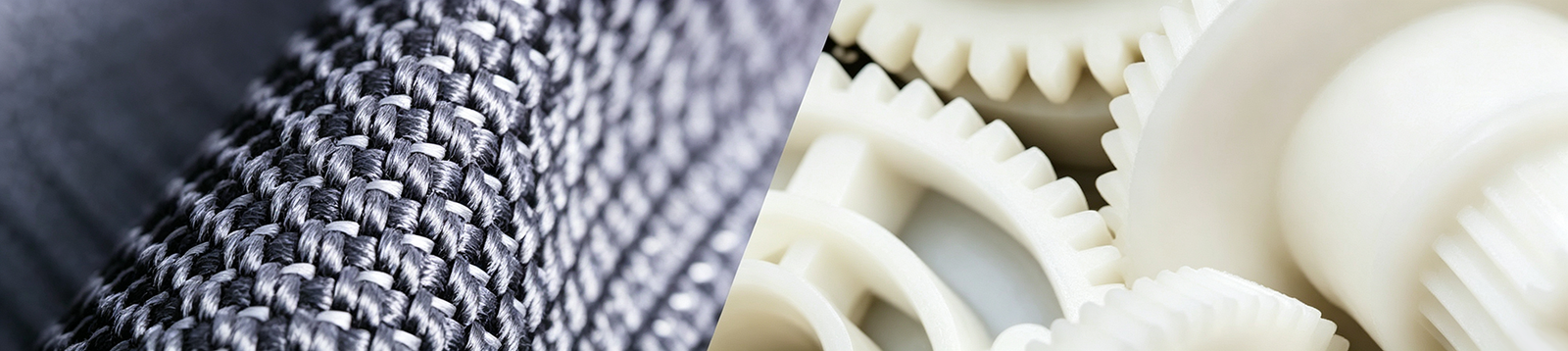
Nylon is a type of polyamide. All nylons are polyamides, but not all polyamides are nylon. Kevlar, Nomex, and PPA are polyamides but not nylon. This guide clarifies the terminology, compares the grades engineers actually specify, and maps each grade to the right manufacturing process.
Ⅰ. Is Polyamide the Same as Nylon?
No. Polyamide is the polymer family defined by amide linkages (-CONH-) in the backbone. Nylon is the trade name for a specific subset — the aliphatic polyamides developed by DuPont in the 1930s.
The naming trap is that the same material carries two names. PA6 is Nylon 6. PA66 is Nylon 6/6. PA12 is Nylon 12. If you write “polyamide” on a drawing or PO without a grade number, the supplier picks what they have in stock — usually the cheapest, which is PA6.
The rule: always specify the grade number (PA6, PA66, PA12, etc.), not just “nylon” or “polyamide.”
Ⅱ. Polyamide Classification: Aliphatic, Aromatic, and Semi-Aromatic
The table below maps scientific names to trade names across all polyamide categories:
| Scientific Name | Trade Name | Chemical Category |
|---|---|---|
| PA6 | Nylon 6 | Aliphatic polyamide |
| PA66 | Nylon 6/6 | Aliphatic polyamide |
| PA11 | Nylon 11 | Aliphatic polyamide (bio-based) |
| PA12 | Nylon 12 | Aliphatic polyamide |
| PA46 | Nylon 4/6 | Aliphatic polyamide |
| PPA | Polyphthalamide | Semi-aromatic polyamide |
| Aramid | Kevlar / Nomex | Aromatic polyamide |
The chemical category in the table dictates the processing route: aliphatic polyamides (PA6/PA66/PA11/PA12/PA46) are the nylons — machinable, moldable, and 3D-printable; aromatic polyamides (aramids) are fibers only, not machined or molded; semi-aromatic polyamides (PPA/PA6T) offer higher stiffness and heat resistance than nylons, used primarily in injection molding for metal replacement in automotive and electronics.
Natural polyamides also exist (wool and silk are protein-based polyamides), but in manufacturing contexts “polyamide” means the synthetic variety.
Ⅲ. Key Nylon/Polyamide Grades Compared
Since the grade number determines melting point, moisture absorption, shrinkage, and process compatibility, selection requires side-by-side comparison. The table below compares the main grades engineers and sourcing teams actually encounter — across tensile strength, melting point, moisture absorption, and key properties:
| Grade | Trade Name | Tensile Strength | Melting Point | Moisture Absorption | Key Property |
|---|---|---|---|---|---|
| PA6 | Nylon 6 | 40–80 MPa | 220–223 °C | High (2.5–3.5%) | Tough, easy to process, low cost |
| PA66 | Nylon 6/6 | ~85 MPa | 255–260 °C | High (2.0–3.0%) | Higher strength and heat resistance than PA6 |
| PA11 | Nylon 11 | ~40 MPa | 190–210 °C | Low (0.5–1.0%) | Bio-based (castor oil), flexible, impact-resistant |
| PA12 | Nylon 12 | 40–50 MPa | ~180 °C | Lowest (0.5–1.0%) | Dimensional stability, chemical resistance |
| PA46 | Nylon 4/6 | Higher than PA66 | ~295 °C | Moderate (1.5–2.0%) | Highest melting point, 50× fatigue life of PA66 |
| PPA | Polyphthalamide | >PA66 | 320–345 °C processing | Low (<1.0%) | Metal-grade stiffness, heat resistance |
| Aramid | Kevlar/Nomex | 3,600 MPa (Kevlar) | >500 °C | Very low | Extreme strength/heat |
PA6 vs PA66: The Most Common Confusion
PA6 and PA66 are not the same material despite similar names. They have different polymerization routes — PA6 is ring-opening polymerization of caprolactam, PA66 is condensation of hexamethylenediamine and adipic acid.
PA66 is roughly 20% stronger, has a higher melting point (260 °C vs 220 °C), and absorbs slightly less moisture. PA6 is easier to process, lower in cost, and produces a better surface finish.
Choose PA66 when strength and heat resistance are the priority. Choose PA6 when cost and processability matter more and the mechanical requirements are moderate.
In practice, the confusion extends beyond PA6 and PA66 — PA12 is also in the mix. The three grades span nearly 80 °C in melting point (180–260 °C) and 7× in moisture absorption (0.5% to 3.5%), with completely different processing parameters and part performance.
PA11 vs PA12: Low-Absorption Grades for 3D Printing
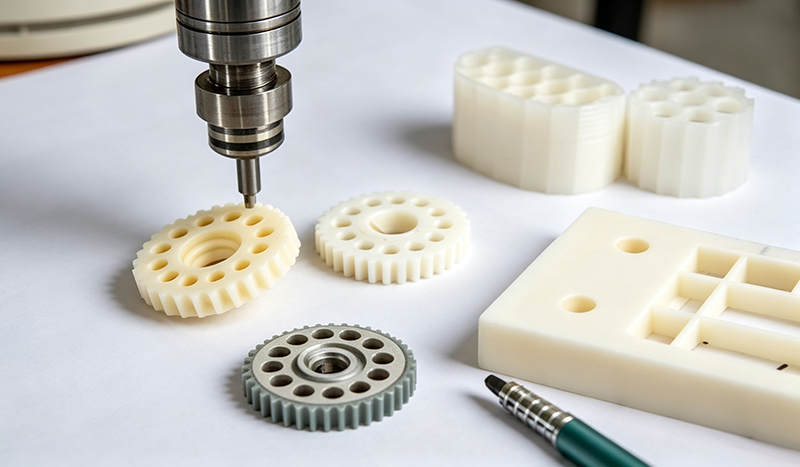
PA11 and PA12 both absorb significantly less moisture than PA6/66, which makes them the preferred grades for SLS and MJF 3D printing. Their low moisture absorption means printed parts hold dimensional tolerance better in humid environments.
PA11 is bio-based, derived from castor oil. It is more flexible and has better impact resistance at low temperatures. PA12 has a slightly lower melting point, better chemical resistance, and is more common in SLS powder formulations.
The decision: PA11 for toughness and flexibility, PA12 for dimensional stability and chemical resistance.
Glass-Filled Nylon: When and Why
Glass fiber reinforcement (typically 13–33% by weight) boosts stiffness, strength, and heat resistance to levels that compete with die-cast metal. A 30% glass-filled PA66 can reach tensile strengths of 180–185 MPa — close to some aluminum alloys.
The trade-offs are significant. Glass-filled nylon is abrasive: it wears CNC cutting tools faster and erodes injection mold cavities over time. It is less ductile, more prone to warpage due to anisotropic fiber orientation, and costs 20–40% more than unfilled grades.
Use 30% GF for structural parts and metal-replacement applications. Use unfilled grades for prototypes, flexible components, and parts where impact resistance matters more than stiffness.
Ⅳ. Moisture Absorption: The Hidden Dimensional Risk
Moisture absorption is the property most often overlooked when specifying nylon — and it directly affects dimensions.
PA6 and PA66 absorb 2.5–3.5% moisture at equilibrium (23 °C, 50% RH). This is enough to swell the part by 0.5–1.5% in linear dimensions and reduce tensile stiffness by 30–50% when wet. A part machined to ±0.05 mm tolerance from dry PA66 stock can drift out of tolerance after a few days in a humid environment.
PA11 and PA12 absorb less than 1.0% — their dimensional change in humid conditions is negligible for most applications.
Datasheet tip: always check “moisture absorption at equilibrium” before specifying. If the part operates in a humid environment and tolerance is tight, switch to PA12 or consider POM.
Ⅴ. Manufacturing Process Selection by Grade
Different grades are suited to different processes. The matrix below maps the common grades to their best-fit manufacturing routes:
| Process | Best Grades | Why |
|---|---|---|
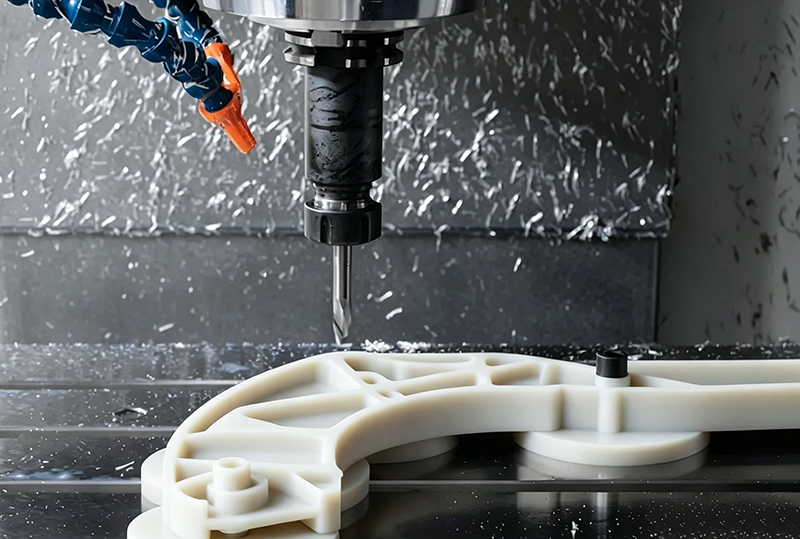
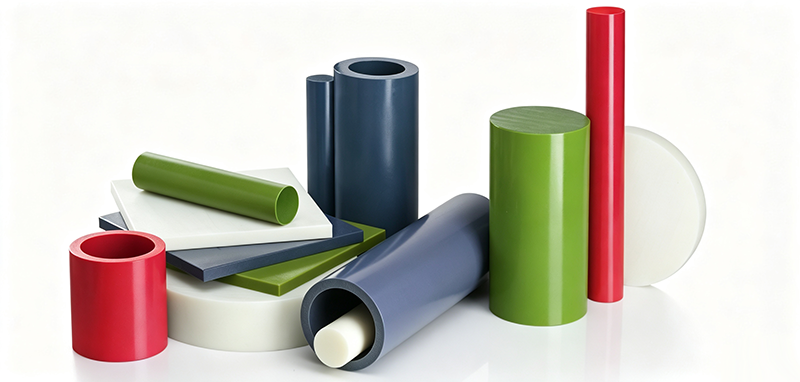
| CNC Machining | PA6, PA66 (cast/extruded stock) | Available as rod/sheet stock, machinable, good dimensional stability when dry |
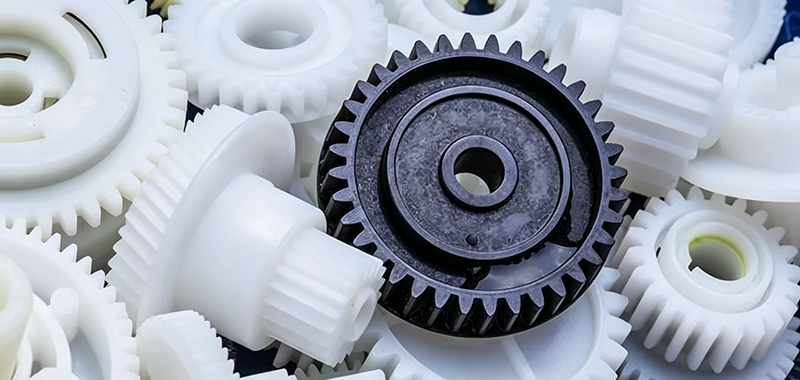
| Injection Molding | PA66, PA6, PA46, PPA | High-volume, complex geometries, filler compatibility |
| SLS 3D Printing | PA12, PA11 | Powder form, low absorption, SLS-optimized grades available |
| MJF 3D Printing | PA12 | HP-developed grades, fine feature resolution |
| FDM 3D Printing | PA6, Nylon 12 | Filament available, lower-cost prototyping |
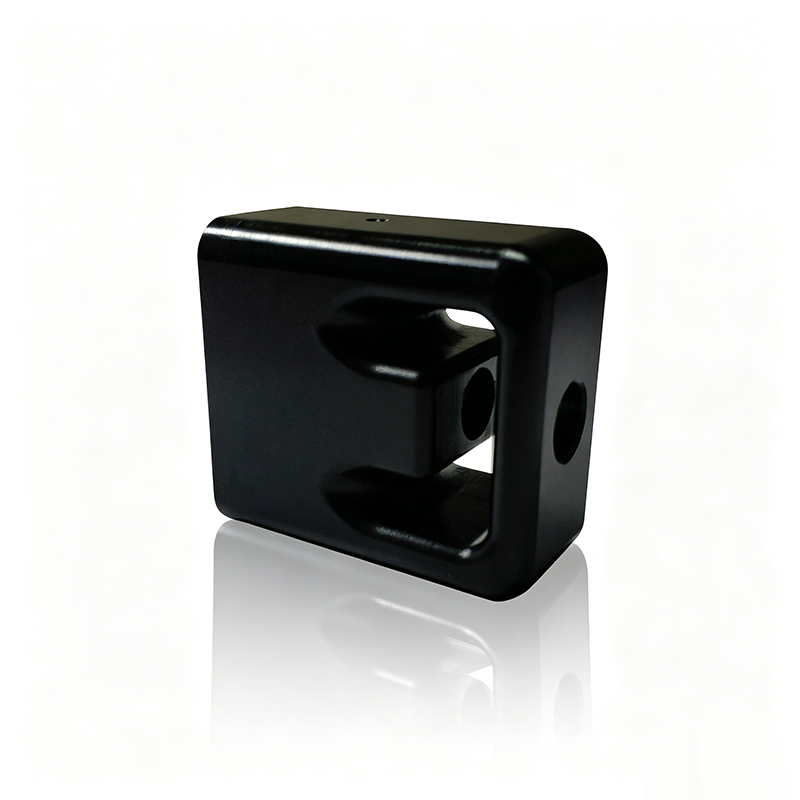
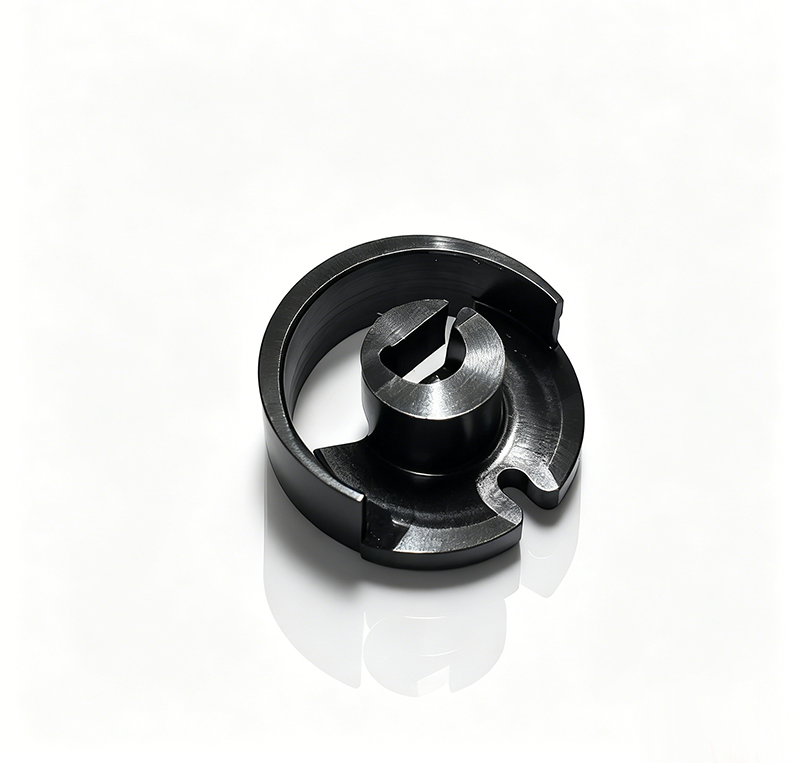
CNC Machining Nylon: What to Watch
- Moisture: machine from dry stock or tolerance drifts after equilibrium. If the material has been sitting in ambient conditions, bake before machining (80 °C, 4–8 hours).
- Thermal expansion: nylon’s coefficient of thermal expansion is 5–10× higher than metal. Account for this in tight-tolerance assemblies.
- Glass-filled grades: use carbide or diamond-coated tooling. Expect tool wear 3–5× faster than unfilled nylon.
- Surface finish: nylon machines to a smooth finish, but dull tools cause fuzzing rather than clean cutting. Keep tools sharp.
Injection Molding Nylon: Drying and Shrinkage
- Drying: PA6/66 must be dried to below 0.1% moisture (80–105 °C, 6–16 hours) before molding. Wet resin causes splay, silver streaks, and brittleness.
- Shrinkage: PA6 shrinks 1.0–2.0%, PA66 shrinks 1.5–2.5%. Glass-filled grades shrink less but shrink anisotropically — design draft angles and radii accordingly.
- Mold temperature: 60–80 °C for PA6/66, 30–100 °C for PA11/12.
- Glass-filled: lower shrinkage but more abrasive on mold cavities. Hardened steel molds are recommended for production volumes.
3D Printing Nylon: SLS, MJF, and FDM
- SLS: PA12 is the workhorse grade. Powder bed fusion requires no support structures, handles complex geometries, and produces parts with mechanical properties close to injection-molded nylon.
- MJF: PA12 with HP-developed material formulations. Finer feature resolution than SLS, faster build times, and consistent mechanical properties.
- FDM: PA6 and Nylon 12 filaments are available. Lowest cost for prototyping, but lower resolution and requires a heated chamber to prevent warping.
- Post-processing: SLS and MJF parts can be vapor smoothed, dyed, or bead blasted for improved surface finish.
Ⅵ. Cost Comparison Across Grades and Processes
Raw material cost increases as you move up the grade hierarchy:
PA6 (lowest) < PA66 < PA12 < PA11 < PA46 < PPA < aramid (highest)
PA6 typically costs 30–40% less than PA66. PA12 powder for SLS costs 3–5× more per kilogram than PA6 pellets, but the per-part cost for low-volume SLS production can be lower than injection molding when tooling cost is included.
Process cost also varies:
- FDM 3D printing — lowest cost for single prototypes, no tooling
- SLS/MJF — cost-effective for 10–500 parts, no tooling
- CNC machining — cost-effective for 1–50 parts in rod/sheet stock, no tooling
- Injection molding — high upfront tooling cost ($5,000–$50,000+), lowest per-part cost at volumes above 500–1,000
Glass-filled grades add 20–40% to material cost but can eliminate the need for a metal part, reducing total assembly cost and weight.
Rule of thumb: prototype with SLS PA12; produce at volume with injection-molded PA66; machine one-off precision parts from PA6/66 rod stock.
Ⅶ. When to Choose Polyamide/Nylon vs Other Plastics
Nylon is not always the right choice. The comparison below covers common alternatives:
| Material | When Nylon Wins | When Alternative Wins |
|---|---|---|
| POM (Acetal) | When wear resistance and toughness are needed | When dimensional stability in wet environments is critical (POM absorbs almost no moisture) |
| PEEK | When moderate-cost engineering plastic is sufficient | When extreme chemical and heat resistance is needed (PEEK continuous use: 250 °C) |
| PP (Polypropylene) | When stiffness and mechanical strength are needed | When chemical resistance and low density are the priority |
| ABS | When wear resistance and thermal stability are needed | When cost is the only factor and performance requirements are low |
Nylon occupies the middle ground: better mechanical performance than ABS or PP, significantly cheaper than PEEK, but more moisture-sensitive than POM.
Ⅷ. Common Mistakes in Specifying Nylon/Polyamide
- Writing “nylon” on a drawing without a grade number — the supplier picks the cheapest, usually PA6, which may not meet your strength or heat requirements.
- Specifying “polyamide” generically on a PO — could result in PA6, PA66, or PA12, whose melting point, moisture absorption, and shrinkage differences are large enough to cause processing failures or out-of-spec parts.
- Not accounting for moisture absorption in tolerance stack-up — PA6/66 parts drift dimensionally in humid environments. If tolerance is tight, specify PA12 or add a note about dry-state machining.
- Using unfilled PA66 where glass-filled is needed — structural or load-bearing parts may deflect or creep under load. Or the reverse: using glass-filled where flexibility is needed, resulting in brittle failure.
- Not drying nylon before injection molding — wet pellets cause splay marks, reduced molecular weight, and brittle parts. Drying is non-negotiable for PA6/66.
- Confusing PA6 with PA66 — different melt points (220 vs 260 °C), different shrinkage rates (1.5% vs 2.0%), different processing windows. They are not interchangeable.
Conclusion
“Polyamide vs nylon” is a terminology question, not a material comparison. The practical decision is which grade to specify — PA6, PA66, PA11, PA12, PA46, or PPA — and which manufacturing process fits that grade and your production volume.
Always specify the grade number on drawings and POs. “Nylon” without a number is ambiguous; “polyamide” without a number is more ambiguous. The grade determines melting point, moisture absorption, shrinkage, cost, and process compatibility.
FAQ
1. Can I use “nylon” and “polyamide” interchangeably on a purchase order?
No. “Nylon” refers to aliphatic polyamides (PA6, PA66, PA11, PA12, PA46). “Polyamide” is broader, also covering semi-aromatic (PPA) and aromatic (aramid) grades. A PO that says “polyamide” without a grade number could result in receiving a grade with very different performance characteristics.
2. What does the number in Nylon 6/6 mean?
The numbers indicate the number of carbon atoms in the monomers. Nylon 6/6 is made from two 6-carbon monomers (hexamethylenediamine and adipic acid). Nylon 6 is made from a single 6-carbon monomer (caprolactam). The numbers do not indicate quality or performance level — they identify the polymer structure.
3. What should I put on a drawing to prevent moisture-related tolerance issues?
Add a note specifying “machine from dry stock” and the required conditioning state before final inspection. For PA6/66 parts with tight tolerances in humid environments, either specify PA12 as an alternative or add a bake requirement (80 °C, 4–8 hours before machining). Including the equilibrium moisture range in the material callout signals to the supplier that moisture is a known risk.
4. Can I swap PA6 for PA66 on an existing injection mold without retooling?
Usually yes for the mold itself — PA6 and PA66 have similar shrinkage ranges (1.0–2.5%), so cavity dimensions are close. But the processing window changes: PA66 requires higher melt temperature (260 vs 220 °C), and substituting PA6 for PA66 produces a part roughly 20% weaker. Always confirm with the molder and re-validate mechanical properties before substituting.
5. Is glass-filled nylon harder to machine?
Yes. Glass fibers are abrasive and wear cutting tools 3–5× faster than unfilled nylon. Use carbide or diamond-coated tooling, reduce cutting speeds, and expect shorter tool life. The trade-off is significantly higher stiffness and strength.
6. Which polyamide is best for high-temperature applications?
PA46 (melting point ~295 °C, continuous use up to 160 °C) or PPA (processing temperature 320–345 °C, continuous use up to 180 °C). For extreme temperatures above 200 °C, consider PEEK instead. PA6 and PA66 are limited to continuous use around 80–120 °C.