Ⅰ. Introduction
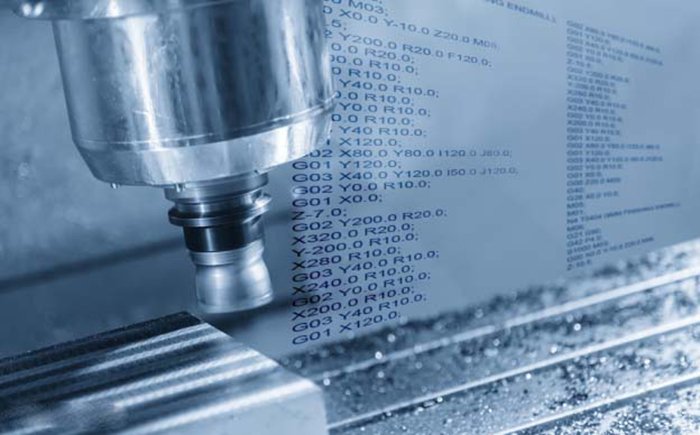
In CNC machining, machine tools rely on programs to control every step of their operation. These programs consist of a series of codes that instruct the machine when to move, where to cut, and how to process the material. Among these, G-code and M-code are the two most common and fundamental types of instructions. They act as “operational commands,” working together to control the machine tool in performing various machining operations. Understanding these two types of codes is the foundation for grasping the principles of CNC machining and achieving stable production.
Ⅱ. What is G-code for CNC Machines?
G-code is the programming language for CNC machines, also known as preparatory function codes, and is primarily used to control the machine’s motion.
Simply put, it is code that tells the machine “how to move,” such as:
- Linear or circular motion
- Rapid traverse or cutting feed
- The path the tool should follow
Through G-code, the machine tool can perform various cutting operations along the set trajectory.

Ⅲ. Common G-codes and Their Functions
The following is a list of common G-codes and their descriptions:
| G Code | Function | Description |
|---|---|---|
G00 |
Rapid Positioning |
Moves the tool to the specified position at maximum speed without cutting; used for non-cutting movements |
G01 |
Linear Interpolation |
The tool cuts in a straight line at the set feed rate |
G02 |
Clockwise Arc | |
G03 |
Counterclockwise Arc | |
G04 |
Pause/Delay |
Program pauses for a specified duration |
G17/G18/G19 |
Machining Plane Selection |
Selects XY/ZX/YZ planes for arc machining |
G28 |
Return to Reference Point |
Tool automatically returns to the machine origin |
G40/G41/G42 |
Tool Radius Compensation |
Off / Left / Right |
G43/G44 |
Tool Length Compensation |
Positive / Negative |
G90 |
Absolute Coordinate Programming |
All coordinate values are relative to the workpiece origin |
G91 |
Relative coordinate programming |
All coordinate values are relative to the current position |
Ⅳ. What are M Codes in CNC Machine Tools?
M codes are auxiliary function commands in CNC machine tools, primarily used to control various operational states of the machine.
Simply put, they tell the machine “when to enable or disable certain functions,” such as:
- Spindle start or stop
- Coolant on or off
- Program pause or end
If G-codes determine “how the machine moves,” then M-codes determine “which auxiliary actions the machine performs.”
Ⅴ. Common M-codes and Their Functions
The following is a list of common M-codes and their descriptions:
| M Code | Function | Description |
|---|---|---|
M00 |
Program Stop |
Stop spindle and feed |
M03/M04 |
Spindle Start |
Start spindle in clockwise/counterclockwise direction |
M05 |
Spindle Stop |
Stop spindle rotation |
M06 |
Tool Change |
Execute automatic tool change |
M08/M09 |
Coolant On/Off |
Turn coolant on/off |
M30 |
Program End and Reset |
End machining and return to program origin |
Ⅵ. How G-Codes and M-Codes Work Together?
In CNC programming, G-codes and M-codes function like a coordinated pair of “actions” and “switches.” G-codes control the tool’s motion path and position, while M-codes control the machine tool’s operations.
The vast majority of systems follow an “M-code first, G-code second” execution sequence. First, M-codes activate auxiliary functions such as the spindle and coolant, followed by G-codes that control the tool’s cutting movements. After machining is complete, M-codes are used to perform final operations such as stopping the spindle and turning off the coolant, collectively ensuring efficient and stable automated machining.
Ⅶ. Frequently Asked Questions (FAQ)
Q: How can I learn more about G-codes and M-codes?
A: There are two approaches. First, systematically study the definitions and execution rules of G-codes and M-codes by referring to the machine tool manual and documentation. Then, write test programs for simple parts to understand the interdependent logic of the commands through hands-on practice. Finally, use CNC simulation software to simulate machining operations and compare the combined application of the two types of codes.
Q:What categories of functional commands do G-codes and M-codes belong to within a CNC system?
A:G-codes are preparatory functional commands in a CNC system, used to define tool paths, machining cycles, and other motion-control-related instructions. M-codes are auxiliary functional commands in a CNC system, used to control machine tool switching operations, process control, and other non-motion-related operations.
Q:What is the main difference between G-codes and M-codes?
A: G-codes control how the tool moves, including its path and position, while M-codes function as control switches, such as turning the spindle on or off and activating the coolant system.
Ⅷ. Summary
G-codes and M-codes are the two core sets of instructions in CNC programming. G-codes enable precise machining of parts through commands such as linear interpolation and circular arc machining, while M-codes control the machine tool’s auxiliary movements and processes. By issuing commands to start and stop the spindle and activate or deactivate coolant, M-codes provide the necessary supporting conditions for cutting operations.
Working in tandem, these two sets of codes form the CNC machining command system, which is key to the efficient and stable production of precision parts.