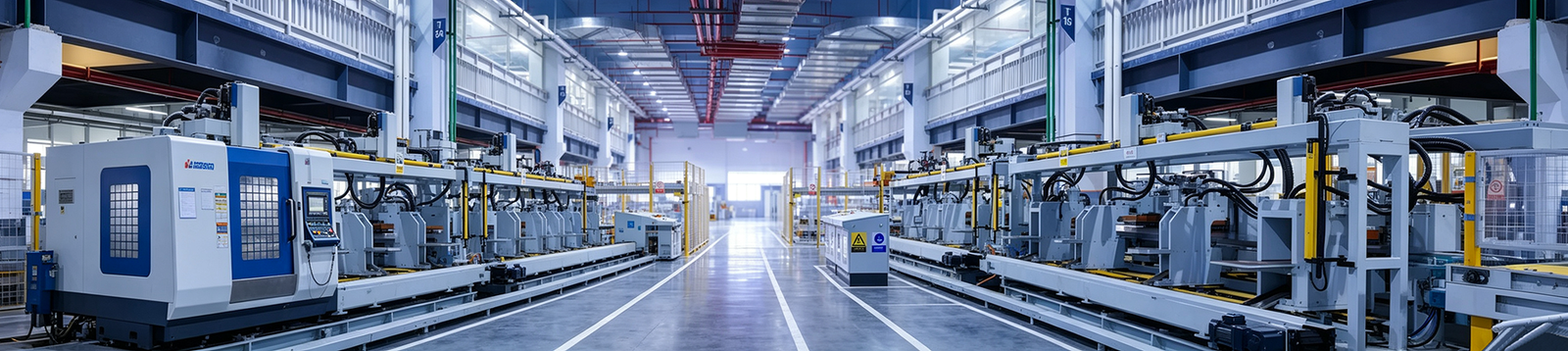
CNC machining is a subtractive manufacturing process in which pre-programmed computer software controls machine tools — mills, lathes, routers, and similar equipment — to cut raw material into a finished part. The “CNC” stands for Computer Numerical Control: the machine reads a coordinate-based program and executes each cutting move without a handwheel or manual operator input.
That definition takes one sentence. What matters if you are the person ordering parts is different: which parts belong on which machine, what tolerance your drawing should actually call out, what the quote will be driven by, and what a good supplier checks in your CAD file before cutting metal.
This guide covers CNC machining from the buyer’s side — how the process works, what it can hold for accuracy, what drives cost, and how to prepare your files so your first quote comes back useful instead of full of questions.
Ⅰ. What Is CNC Machining?
CNC machining removes material from a solid block, bar, or rod — called the workpiece or blank — using rotating cutting tools guided by programmed toolpaths. A typical CNC sequence runs like this:
1. A CAD model defines the part geometry.
2. CAM software converts that geometry into tool paths — coordinate-based instructions for tool position, spindle speed, and feed rate.
3. The CNC controller executes those paths, moving the tool or the workpiece along machine axes.
4. The machine repeats every move identically across every part in the batch.
Two properties make CNC machining the default choice for precision metal parts:
- Repeatability. Once the program is proven, part 500 matches part 1. This is what makes CNC economical at batch sizes where manual machining would drift.
- Accuracy. Modern CNC machines hold tolerances that manual operations cannot repeat — typically ±0.01–0.05 mm (±0.0004–0.002 in) as standard, tighter on critical features.
CNC is a control method, not a single process. What is a CNC machine, exactly? Any machine tool — mill, lathe, router, grinder, or EDM machine — whose motion is governed by a computer numerical controller. That is why “CNC machining” as a keyword covers so much ground: the machine type determines what geometry you get, and the CNC control determines consistency.

Ⅱ. How Does CNC Machining Work? From CAD File to Finished Part
Understanding the CNC machining process helps you see where quotes come from and where projects stall. Five stages:
1. CAD Model and Drawing
You supply a 3D model (STEP, IGES, or Parasolid are standard) plus a 2D drawing when tolerances, surface finish requirements, or thread specs need to be explicit. The model defines geometry; the drawing defines what “good” means. If a feature’s tolerance is not on the drawing, the shop will apply its general tolerance — which may or may not match your intent.
2. DFM Review
Before quoting, the supplier’s engineering team checks the design against machine capabilities: can tools reach every feature, are walls thick enough, are internal radii manufacturable, is the tolerance achievable in the chosen material. A DFM review at this stage costs nothing and prevents the most expensive category of manufacturing failure — discovering a design issue after material is already cut.
3. Programming and Setup
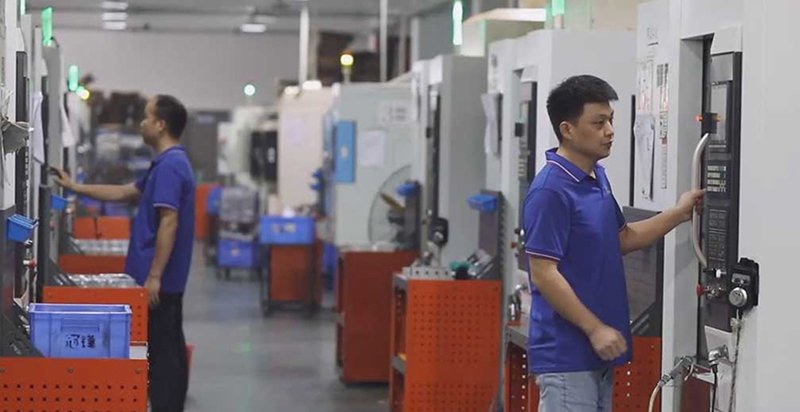
A CAM programmer selects tools, cutting speeds, and workholding; the machine operator fixtures the blank. Setup time is a fixed cost per batch — one reason a 10-part order costs more per part than a 1,000-part order.
4. Machining
The machine executes roughing passes (removing bulk material quickly) then finishing passes (holding final dimensions and surface finish). Critical dimensions are measured in-process or between operations.
5. Inspection and Finishing
Final parts are inspected — CMM measurement for critical features — then deburred, surface-finished if required, and shipped. For regulated industries, this stage also produces the documentation: dimensional reports, material certificates, first article inspection (FAI).
Ⅲ. Types of CNC Machines and What They Make
The machine type matches part geometry — this single decision drives most of your cost.
| Machine | How It Works | Best For | Typical Parts |
|---|---|---|---|
| CNC Mill (3-axis) | Rotating tool, fixed workpiece, X/Y/Z movement | Prismatic parts, flats, pockets, slots | Brackets, housings, plates |
| CNC Mill (4/5-axis) | Adds rotation axes, fewer setups | Complex 3D geometry, angled features | Turbine parts, impellers, aerospace structural |
| CNC Lathe / Turning Center | Rotating workpiece, fixed single-point tool | Rotational-symmetric geometry | Shafts, bushings, fittings, pins |
| Swiss-Type Lathe | Bar stock feeds through guide bushing | Long, slender parts (high L/D ratio) | Watch components, medical pins, fasteners |
| Mill-Turn Center | Turning plus live milling tools in one setup | Parts mixing round + prismatic features | Shafts with milled flats and cross-holes |
| CNC Router | High-speed milling for sheet/panel materials | Large flat parts, wood, plastics | Panels, signs, enclosures |
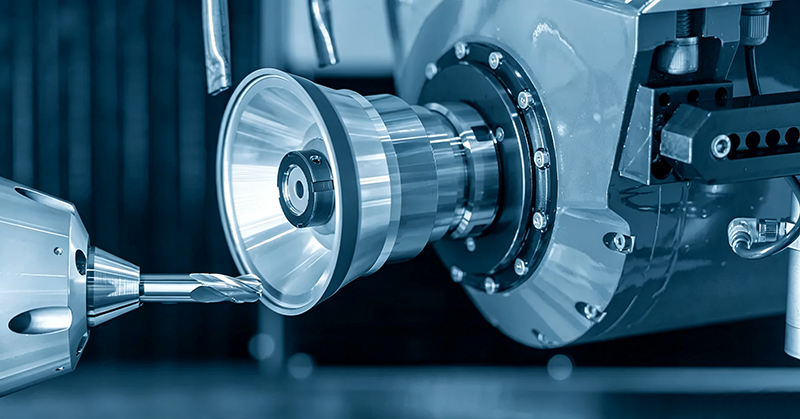
| CNC Grinding | Abrasive wheel removes micro-scale material | Tight tolerances, fine surface finish | Gauge parts, bearing surfaces |
| Wire/Sinker EDM | Electrical sparks remove conductive material | Hardened steel, sharp internal corners | Dies, molds, hard tooling |
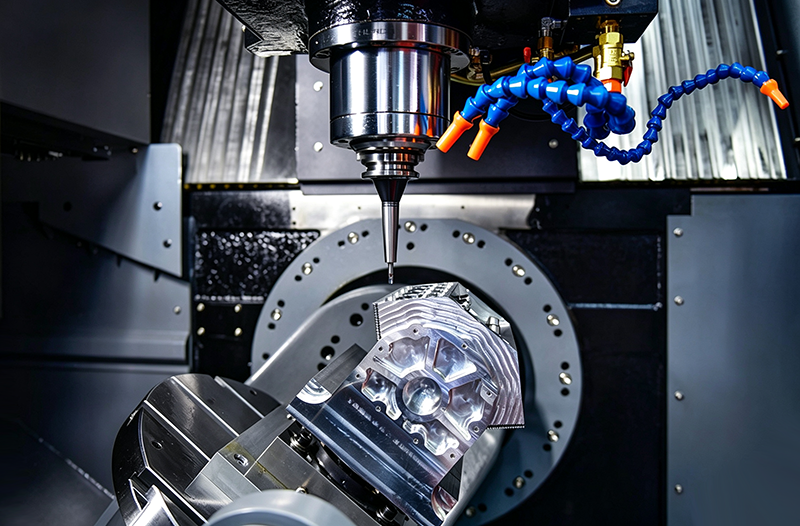
A 5-axis CNC machine adds two rotary axes to the standard three linear ones, so complex geometry like turbine blades, impellers, and angled features can be finished in one setup instead of three or four — fewer setups means tighter accumulated tolerance and lower cost.
For a deeper comparison of the two most common machine types, see [Lathe vs Mill: Differences, Tolerances & Costs] — the short version: if the part is mostly round, it belongs on a lathe; if it has pockets, flats, and 3D contours, it belongs on a mill; if it has both, ask about mill-turn.
Ⅳ. Materials Used in CNC Machining
Almost any solid engineering material can be CNC machined. The practical question is machinability — how a material behaves under a cutting tool — because it drives both cost and achievable tolerance.
| Material | Best For | Machinability | Relative Cost |
|---|---|---|---|
| Aluminum (6061, 7075) | Lightweight structures, enclosures, prototypes | Excellent | Low |
| Carbon Steel (1018, 1045) | General mechanical parts, shafts, fixtures | Good | Low |
| Stainless Steel (304, 316, 17-4PH) | Corrosion resistance, medical, food equipment | Moderate | Moderate |
| Alloy Steel (4140, 4340) | High strength, hardened components | Moderate | Moderate |
| Tool Steel (O1, A2, D2) | Dies, molds, wear parts | Difficult | Higher |
| Titanium (Ti-6Al-4V) | Aerospace, medical implants, high strength-to-weight | Difficult — low thermal conductivity | High |
| Brass / Copper | Electrical components, valves, fittings | Good | Moderate |
| Engineering Plastics (PEEK, POM, Nylon, ABS) | Insulators, lightweight parts, chemical resistance | Good | Low–High (material-dependent) |
Two practical notes:
- Aluminum machines roughly 3–4× faster than stainless steel and 5–8× faster than titanium in typical cutting data. If your part does not need the properties of an exotic material, choosing 6061 over Ti-6Al-4V can cut machining cost more than any design change.
- Plastics machine quickly but hold tolerance differently — they move with temperature and humidity. Tight tolerances on large plastic parts need material selection thought through with the supplier.
Ⅴ. CNC Machining Tolerances and Surface Finishes
Tolerance is where drawings and quotes connect. General industry standards for CNC machining:
| Feature | Standard CNC Tolerance | Precision CNC Tolerance |
|---|---|---|
| Linear dimensions | ±0.05–0.1 mm (±0.002–0.004 in) | ±0.01–0.02 mm (±0.0004–0.0008 in) |
| Repeatability | ±0.02 mm (±0.0008 in) | ±0.005 mm (±0.0002 in) |
| Surface finish (Ra) | 1.6–3.2 μm | 0.4–0.8 μm |
Three rules keep tolerance from inflating your quote:
1. Tolerance only critical features. A bearing bore needs a tight tolerance; a cosmetic outside face usually does not. Tight tolerances applied blanket-wide add finishing passes, inspection time, and scrap risk across every dimension on the drawing.
2. Use general tolerances for the rest. ISO 2768-mK or equivalent covers non-critical features at no cost premium.
3. Match tolerance to material and geometry. A ±0.005 mm callout on a thin plastic wall or a long slender feature is asking for scrap. When in doubt, ask the supplier what the geometry can realistically hold — before the drawing is finalized.
For a full breakdown of tolerance levels and their cost multipliers, see the [Precision Machining Buyer’s Guide].
Ⅵ. What Drives CNC Machining Cost
Quotes are not arbitrary — they respond to specific part attributes. The usual drivers, ranked by impact:
| Cost Driver | Why It Costs | Typical Effect |
|---|---|---|
| Material price and machinability | Titanium cuts slow and wears tools; aluminum cuts fast | 2–5× spread between material extremes |
| Setup count | Each new fixture orientation adds setup time and tolerance risk | Multi-setup parts cost more per part |
| Tolerance tightness | Finishing passes, slower feeds, more inspection | Tightening from ±0.05 to ±0.005 mm can multiply cost significantly |
| Part size | Larger blanks, longer cycle times, bigger machines | — |
| Quantity | Fixed setup cost amortizes across the batch | 1–10 parts carry the highest per-piece cost |
| Surface finish and post-processing | Anodizing, polishing, heat treatment are separate operations | — |
| Design features | Deep pockets, thin walls, small internal radii slow cutting | Often the hidden quote driver |
The single most effective cost reduction is free: apply tolerances only where function demands them and confirm that features are manufacturable at the DFM stage. A design revision before cutting is nearly always cheaper than a revision after scrap.
Ⅶ. What DFM Feedback Catches Before Quoting
This is the stage most “what is CNC machining” guides skip — and the one that saves the most money.
When a supplier runs DFM analysis on your CAD file, they are checking whether the design can be manufactured as drawn, at the quoted cost, in the stated material. Typical findings:
- Wall thickness below material limits. Thin walls flex under cutting force and vibrate, causing chatter marks and dimensional drift.
- Internal corner radii too small for standard tools. Every internal corner needs a radius at least as large as the tool that cuts it. Sharp internal corners require EDM, which changes the cost model entirely.
- Tolerances tighter than the process holds reliably. Over-toleranced features get flagged — or should — before they generate scrap.
- Features that need multiple setups. A hole at an odd angle to all primary faces might need a 5-axis machine or a custom fixture. Sometimes a small design change eliminates an entire setup.
- Deep pockets with high aspect ratios. Long, slender tools deflect; deep pockets need specialized tooling and slower passes.
- Missing or ambiguous drawing callouts. Threads, surface finishes, and edge treatments that the model does not capture.
A supplier that returns a quote with no DFM feedback and no questions is either exceptionally efficient or not looking. The suppliers worth working with come back with comments — because the alternative is discovering the issue at inspection.
Ⅷ. How to Prepare Your Files for a CNC Quote
The fastest way to a useful quote is a complete RFQ. What suppliers need:
- 3D model in STEP, IGES, or Parasolid — the universal formats. Native CAD files work but add a conversion step.
- 2D drawing with GD&T when tolerances, finishes, or thread specs are critical.
- Material specification — grade, not just family (“6061-T6” not “aluminum”; “316L” not “stainless”).
- Quantity and batch plan — quoting 10 parts now and 10,000 later changes the recommended process and price.
- Surface finish and post-processing — anodizing, painting, heat treatment, deburr level.
- Lead time constraint — if the part is needed in 5 days versus 3 weeks, that changes routing options and price.
What slows quotes down: models without drawings for tolerance-critical parts, materials specified as “any steel will do,” and requests with no quantity. Each of these forces a back-and-forth round before the real quote can even start.
Ⅸ. How to Evaluate CNC Machining Services
For a full evaluation framework, see the [Precision Machining Buyer’s Guide] supplier chapter. The short checklist for comparing CNC machining services:
- Capabilities match. 3/4/5-axis milling, turning, mill-turn, grinding, EDM — do they run the processes your part needs, or will it be subcontracted?
- Quality system. ISO 9001 as a baseline; AS9100 for aerospace, ISO 13485 for medical, IATF 16949 for automotive.
- Inspection equipment. CMM capability and willingness to provide dimensional reports — not just “we check every part.”
- DFM support. Engineering feedback on your drawing before quoting, not after problems.
- Material traceability. Certificates with shipments when your application requires them.
- Communication. English-language engineering contact, response time, and clear project tracking — the factor most consistently underestimated in offshore sourcing.
Ⅹ. When CNC Machining Is Not the Answer
CNC is the most versatile metal process, but not always the right one:
- Very high volumes of simple parts. Once annual volume justifies tooling, die casting or injection molding (for plastics) beats machining on per-piece cost.
- Extremely complex internal geometry. Lattice structures and internal channels that tools cannot reach belong on metal 3D printing (DMLS).
- Sheet-metal forms. Enclosures and brackets made from thin sheet are laser-cut and bent, not machined from solid — a different process family with its own cost model.
- One-off hobby needs. If the part does not need precision or repeatability, manual machining or fabrication services cost less.
The decision point is volume and geometry. CNC machining dominates the prototype-to-medium-batch range where tooling investment is not justified and precision matters.
Conclusion
So, what is CNC machining? It is a process that uses computer-controlled cutting tools to turn raw material into finished parts, with repeatability manual processes cannot match. For the buyer, the decisions that matter are practical: match the machine type to part geometry, tolerance only what function demands, and get DFM feedback before material is cut.
The fastest way to start is to put a real drawing in front of a supplier. Upload your CAD files to Keywin for a quote with DFM feedback — you will see process routing, tolerance risks, and cost drivers for your specific part before anything is cut.
FAQ
1. How does CNC machining work compared to 3D printing?
CNC machining is subtractive — it removes material from a solid blank. 3D printing is additive — it builds material up layer by layer. CNC offers tighter tolerances, better material properties, and lower per-part cost at moderate volumes; 3D printing wins on geometry that tools cannot reach and on parts where no tooling or fixturing exists.
2. What is CNC machining used for?
Typical uses: machined structural and functional parts — brackets, housings, shafts, fittings, and fixtures — in aerospace, medical devices, automotive, robotics, electronics, and industrial equipment. It dominates the prototype-to-medium-batch range where precision matters and tooling investment is not justified. Rough guide by volume: 1–1,000 parts and tight tolerance, CNC; tens of thousands of simple parts, die casting or molding takes over.
3. What is the difference between NC and CNC machines?
NC (Numerical Control) is the older technology — programs were hardwired or fed by punched tape, with no editing at the machine. CNC (Computer Numerical Control) stores the program in a computer, so operators can edit it, simulate toolpaths, apply tool-wear and thermal compensation, and run adaptive feeds. Practically every machine tool sold today is CNC; you will mostly encounter “NC” in legacy equipment or vendor documentation.
4. What is a CNC machine shop?
A CNC machine shop is a supplier that runs CNC mills, lathes, and related equipment to produce parts to customer drawings — that is who you are actually buying from when you request a machining quote. Shops vary widely in capability: some offer only 3-axis milling, others run 5-axis, mill-turn, grinding, and EDM with full inspection (CMM) and industry certifications (ISO 9001, AS9100, ISO 13485). The machine table and supplier checklist above tell you what to verify before sending your RFQ.
5. What does CNC machining cost per hour?
Machine hourly rates typically range from roughly $40–50 for basic 3-axis work to $100+ for 5-axis machines, varying by region and shop. But hourly rate is the wrong number to compare — the cheapest rate with the most setups often produces the most expensive part. Compare finished-part quotes, not machine rates.
6. How tight can CNC machining tolerances be?
Standard CNC machining holds ±0.05–0.1 mm (±0.002–0.004 in). Precision work reaches ±0.01–0.02 mm (±0.0004–0.0008 in), and grinding or specialized processes push below ±0.005 mm (±0.0002 in). Achievable tolerance depends on material, geometry, and part size — thin features and plastics hold less than rigid steel parts.
7. What file formats do CNC machining services accept?
STEP and IGES are the universal 3D formats; Parasolid also works with most suppliers. A 2D drawing (typically PDF) with GD&T callouts is needed when tolerances, threads, or finishes are critical. Native CAD files (SolidWorks, Fusion, NX) are accepted by many suppliers but add a conversion step.
8. Is CNC machining good for prototypes or production?
Both — it is the only major process that serves both without tooling change. For prototypes, CNC delivers production-representative material properties in days. For production, it remains economical from one-off to roughly the low thousands of parts, where its flexibility offsets tooling-based processes.
9.What is the difference between CNC milling and CNC turning?
Milling spins a multi-flute cutter while the workpiece stays fixed — best for flats, pockets, and 3D geometry. Turning spins the workpiece against a single-point tool — best for cylindrical parts. Many parts need both, which is what mill-turn centers provide in one setup.