
Most tungsten vs titanium decisions go wrong at the comparison basis, not the property table: the part arrives overweight, deflects under load, or lands in a process the geometry never supported. For engineering applications, titanium is usually the starting point when low mass, high specific strength, and corrosion resistance govern the part. Tungsten and its alloys are usually the starting point when density, stiffness, heat exposure, or concentrated mass governs it.
One clarification applies to every titanium vs tungsten comparison: “tungsten” can mean pure tungsten or a tungsten heavy alloy, while “titanium” can mean commercially pure grades or alloys such as Grade 2 and Ti-6Al-4V. Tungsten carbide is not tungsten metal, and titanium carbide is not titanium. The useful comparison must name the material form, grade, and condition.
Ⅰ. Tungsten vs Titanium at a Glance
| Comparison factor | Tungsten | Titanium | Selection implication |
|---|---|---|---|
| Density and weight | Very high; pure W ≈19.25 g/cm³ | Much lower; Ti-6Al-4V ≈4.42 g/cm³ | Titanium removes mass; tungsten concentrates it |
| Strength | Depends strongly on form and processing; pure W is brittle at room temperature | Ti-6Al-4V offers high useful specific strength | Name the grade and the strength property |
| Hardness | Pure W, WHA, and carbide are different categories | Varies by grade and heat treatment | Hardness alone is not durability |
| Stiffness | Pure W modulus is about 400 GPa | Ti-6Al-4V is typically about 107–122 GPa | Identical geometry deflects less in tungsten |
| Temperature | Very high melting point; oxidation limits unprotected use in air | Lower melting point; useful alloy properties depend on temperature and condition | Atmosphere matters as much as temperature |
| Corrosion | Environment- and alloy-dependent | Excellent in many media because of its passive oxide film | Specific chemistry decides |
| Machinability | Material form determines whether cutting, grinding, or EDM is appropriate | Low conductivity and chemical reactivity challenge tools | Both require process-specific planning |
| Cost | Powder route, stock form, density, and machining dominate | Grade, material yield, and machine time dominate | Compare finished-part cost, not price per kilogram |
What Are Tungsten and Titanium?
What Is Tungsten?
Tungsten is a refractory metal with the highest melting point of any metal—about 3,420–3,422°C. Pure tungsten has a density near 19.25 g/cm³ and an elastic modulus around 400 GPa. It is brittle at room temperature, and commercial tungsten products are commonly made through powder-metallurgy routes, although the manufacturing route depends on the product form.
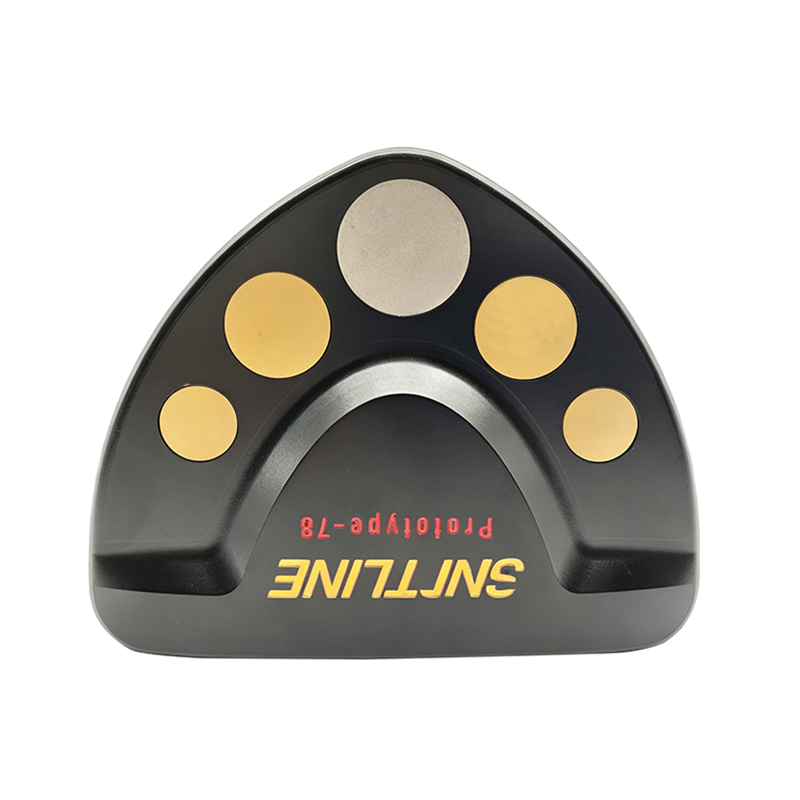
Pure tungsten serves high-temperature and electrical applications under suitably controlled conditions. Tungsten heavy alloys (WHA) use tungsten with a nickel-iron or nickel-copper binder to provide high density with better ductility and machinability. ASTM B777-15(2026) defines four classes of machinable high-density tungsten-base material. The class, composition, magnetic requirement, and certified properties should be stated on the purchase specification rather than inferred from density alone. Cemented tungsten carbide is a separate composite used mainly for wear surfaces and cutting tools.
What Is Titanium?
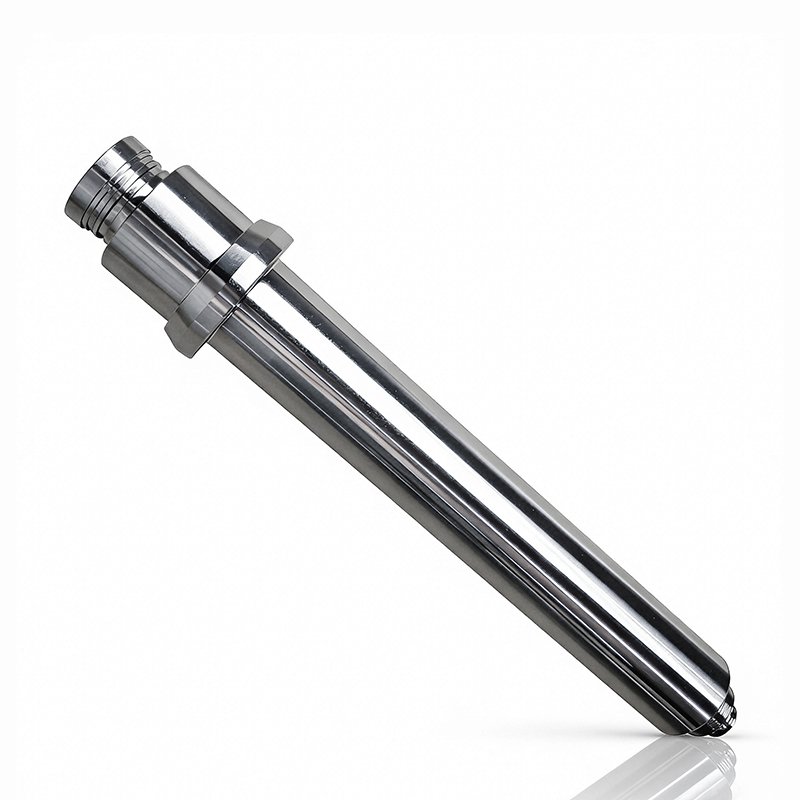
Titanium is a low-density metal whose stable oxide film provides strong corrosion resistance in seawater and many chemical environments. Commercially pure Grade 2 is valued for ductility, formability, and corrosion resistance. Ti-6Al-4V (Grade 5) is a widely used alpha-beta alloy that combines low density with relatively high strength. Grade, heat treatment, product form, and service temperature all affect the property values used in design.
Ⅱ. Density and Weight: Is Tungsten Heavier Than Titanium?
Yes. For identical geometry, a tungsten-based part is roughly four times heavier than a titanium part because mass follows density directly.
Mass = Density × Volume
For an illustrative 10 cm³ part—a cube about 21.5 mm per side—the comparison is:
| Material (clearly labeled) | Density | Mass at 10 cm³ |
|---|---|---|
| Ti-6Al-4V | ≈4.42 g/cm³ | ≈44 g |
| CP titanium Grade 2 | ≈4.5 g/cm³ | ≈45 g |
| Representative ASTM B777 Class 3 WHA* | ≈18.0 g/cm³ nominal | ≈180 g |
| Pure tungsten | ≈19.25 g/cm³ | ≈193 g |
*The Class 3 value is shown as a representative supplier nominal value, not as a substitute for the controlled ASTM standard or a supplier certificate. Verify the current specification, alloy designation, and certified lot data before design release.
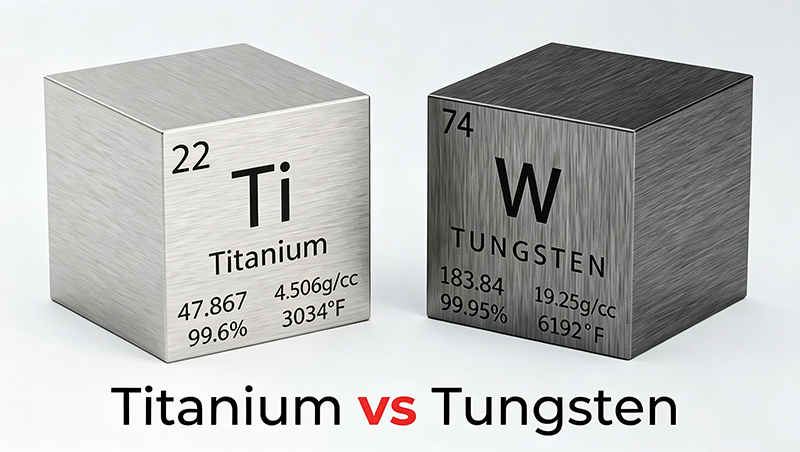
The same geometry therefore carries about four times the mass in a tungsten-based material. Titanium suits rotating parts, brackets, and housings where mass must be removed. Tungsten heavy alloy suits counterweights, balancing masses, and shielding where mass must fit into a limited envelope. At equal mass, titanium provides much more volume that can be distributed into deeper sections or ribs.
Ⅲ. Strength, Hardness, and Stiffness
The question “which is stronger, tungsten or titanium?” has no single answer. Yield strength, tensile strength, hardness, stiffness, fracture behavior, and specific strength rank the materials differently.
Tensile and Yield Strength
Absolute strength depends on grade, product form, processing condition, direction, and temperature. Annealed Ti-6Al-4V commonly provides high yield strength for its mass, while commercially pure Grade 2 is lower-strength and more formable. Pure tungsten’s room-temperature performance is strongly influenced by brittleness and product history. Titanium alloys generally offer much higher useful specific strength than pure tungsten, but a defensible design comparison must use certified values for the selected grades and conditions.
Hardness and Wear Resistance
Hardness comparisons fail when tungsten metal and tungsten carbide are treated as the same material. Cemented carbide can be dramatically harder than either metal, while the hardness of pure tungsten, WHA, and titanium alloys varies with composition and condition. Hardness does not predict impact resistance, fatigue life, or fracture toughness by itself.
Stiffness and Deformation
Stiffness is controlled by elastic modulus and geometry, not yield strength. Pure tungsten’s modulus is roughly three to four times that of Ti-6Al-4V, so identical geometry generally deflects less in tungsten. Geometry can reverse the practical result: a titanium part with deeper ribs or a larger section can be stiffer at much lower mass because bending stiffness changes strongly with section shape.
Ⅳ. Heat Resistance and Thermal Behavior
Tungsten’s melting point is about 3,420–3,422°C, the highest of any metal. Ti-6Al-4V melts at roughly 1,650–1,660°C. Melting point is not a service-temperature rating. Unprotected tungsten oxidizes increasingly in air at elevated temperatures, so its extreme-temperature capability normally requires a suitable vacuum, inert atmosphere, protective environment, or application-specific allowance. TIMET reports that Ti-6Al-4V retains reasonable properties to about 350°C, but allowable temperature must still be based on the selected product, condition, load, exposure time, and design code.
Thermal conductivity also differs sharply. Representative room-temperature values are about 170 W/m·K for pure tungsten and about 6.6 W/m·K for mill-annealed Ti-6Al-4V. Mean thermal expansion is correspondingly lower for tungsten than for Ti-6Al-4V. These values affect thermal gradients, cutting temperature, press fits, and dimensional stability; the design value should come from the applicable material data sheet.
Ⅴ. Corrosion Resistance and Environmental Performance
Titanium’s corrosion resistance comes from a stable, self-repairing passive oxide film. It performs well in seawater and many oxidizing environments, but it is not universally immune: fluoride-containing media, some reducing acids, hot dry chlorine, and unfavorable crevice conditions can be problematic.
Tungsten and tungsten heavy alloys behave differently. Corrosion depends on the atmosphere, temperature, tungsten form, and binder chemistry; in WHA, the nickel-based binder may govern the response before the tungsten phase does. Material selection should therefore begin with a specific media, concentration, temperature, and exposure condition—not a general statement that either metal “does not corrode.”
Ⅵ. Tungsten vs Titanium Machinability
Material form and process planning decide whether the geometry is practical and economical.
Machining Tungsten and Tungsten Alloys
Pure tungsten is brittle at room temperature. Edge chipping and breakout can be significant at sharp corners, thin sections, deep holes, and threads, so grinding or EDM may be more suitable than aggressive conventional cutting for some features. Tungsten heavy alloys machine more conventionally, but their abrasiveness, density, and specific alloy condition affect tool life, fixturing, surface finish, and inspection planning.
Machining Titanium Alloys
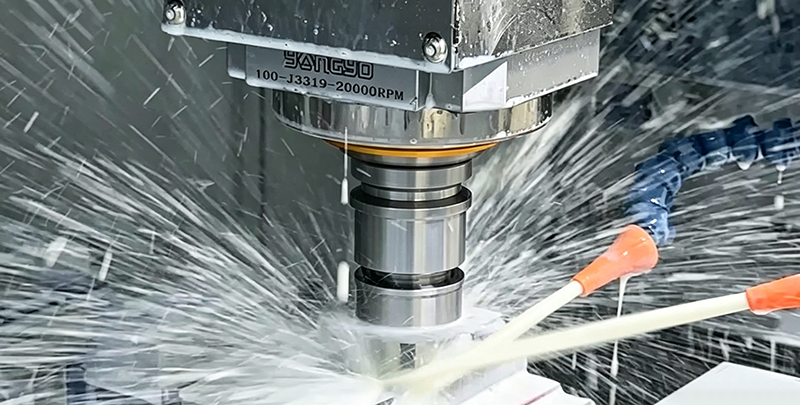
Titanium’s low thermal conductivity limits heat flow into the workpiece and concentrates much of the cutting heat near the tool–chip interface. Chemical reactivity, galling tendency, and tool-edge temperature add to wear. Rigid setups, sharp tooling, controlled engagement, reliable chip evacuation, and correctly applied coolant are important. High-pressure coolant is commonly useful when the machine, tooling, and operation support it; it is not a universal requirement for every titanium cut.
For a broader process overview, see Keywin’s CNC Precision Machining Service.
Which Is Easier to Machine?
Neither material is categorically easier. The answer depends on the exact grade or tungsten form, stock condition, geometry, tolerances, surface finish, quantity, equipment, and inspection requirements. A WHA counterweight with generous tolerances can be straightforward, while a thin-walled Ti-6Al-4V housing with tight feature relationships may demand extensive process control.
Ⅶ. Manufacturing Options Beyond CNC Machining
CNC machining is one route, not the only route. Powder metallurgy can provide economical near-net tungsten-family blanks, while grinding and EDM extend feature access where conventional cutting becomes risky. Titanium is widely available as wrought stock and can be forged, formed, and welded under suitable procedures. Tungsten joining options may include brazing, diffusion bonding, welding in specialized conditions, or mechanical retention, depending on the tungsten form, joint function, and service environment.
Ⅷ. Typical Engineering Applications
| Function | Typical tungsten-family choice | Typical titanium choice |
|---|---|---|
| Concentrated mass | WHA counterweights, balance masses, vibration-control components | Usually not preferred when compact mass is the goal |
| Radiation attenuation | WHA shielding and collimation components | Structural hardware where low mass matters |
| High stiffness in a small envelope | Pure W or WHA, subject to brittleness and processing limits | Larger ribbed geometry where low mass governs |
| Corrosive marine or chemical service | Possible after media-specific review | Commonly Grade 2 or another selected titanium grade |
| Weight-critical structures | Rare | Ti-6Al-4V brackets, housings, rotating and aerospace components |
| Wear and cutting | Cemented tungsten carbide—not tungsten metal | Titanium carbide is a ceramic phase, not a structural titanium substitute |
These pairings are screening points, not final specifications. Every production drawing should end with a named grade, condition, applicable standard, and validated manufacturing route.
Ⅸ. Cost: Is Tungsten or Titanium More Expensive?
There is no fixed answer. A per-kilogram comparison is especially misleading because an equal-volume tungsten part contains roughly four times the mass. Finished-part cost is driven by:
- Raw material grade and certified stock form
- Material yield and chip volume
- Near-net blank versus bar or plate
- Programming, setup, and machining time
- Tooling consumption and coolant strategy
- Scrap risk and process development
- Finishing, inspection, certification, and traceability
- Quantity, availability, and lead time
For more context, see Keywin’s How Material Selection Impacts CNC Machining Price.
Ⅹ. How to Choose Between Tungsten and Titanium
Choose titanium when:
- Weight reduction is a primary design goal
- Specific strength governs the load path
- The service environment favors a verified titanium grade
- The part experiences dynamic motion or inertial loading
- A suitable titanium grade and manufacturing process have been confirmed
Consider tungsten or a tungsten alloy when:
- High mass or density must fit a limited envelope
- The part is a counterweight, shield, or compact high-stiffness element
- Elevated-temperature capability is required and the atmosphere is defined
- The geometry and manufacturing route suit the selected tungsten form
- The added material and processing complexity is justified by the function
Do not release the selection until the grade and material form, loads, temperature and atmosphere, corrosive media, target mass, tolerances, surface requirements, quantity, inspection, and compliance requirements are defined.
Conclusion
Titanium and its alloys win where low weight, high specific strength, and corrosion resistance carry the design. Tungsten and its alloys win where concentrated mass, compact stiffness, radiation attenuation, or extreme-temperature potential matters. The final choice is only defensible when it names a specific material grade and condition, defines the service environment, and matches the geometry to a qualified manufacturing route.
Choosing between tungsten and titanium for a manufactured part? Send Keywin your drawing with the target grade, operating conditions, quantity, and critical tolerances for a manufacturability review.
FAQ
1. Is tungsten stronger than titanium?
It depends on the grade, form, condition, temperature, and the property being compared. Titanium alloys generally provide much higher useful strength relative to their mass, while tungsten provides exceptional density and stiffness. Certified grade-specific data should control the design.
2. Is tungsten heavier than titanium?
Yes. Pure tungsten is about 19.25 g/cm³, compared with about 4.42 g/cm³ for Ti-6Al-4V. Equal-volume tungsten parts are therefore roughly four times heavier.
3. Which is harder, tungsten or titanium?
Do not confuse tungsten metal with tungsten carbide. Cemented carbide is far harder than either structural metal. The hardness ranking between pure tungsten, WHA, and titanium alloys depends on composition and condition.
4. Is tungsten more heat-resistant than titanium?
Tungsten has the higher melting point, but usable temperature depends on oxidation, atmosphere, time, load, and product form. A melting-point comparison alone is not a service-temperature decision.
5. Which is easier to machine?
Neither has one universal advantage. Pure tungsten is brittle, WHA is dense and abrasive, and titanium concentrates heat near the cutting edge and tends to gall. Grade, geometry, tolerances, quantity, and equipment can change the answer.
6. Is tungsten more expensive than titanium?
Finished-part cost is case-specific. Compare the actual stock form, density, material yield, machining time, tooling, scrap risk, finishing, inspection, and quantity rather than commodity price per kilogram.